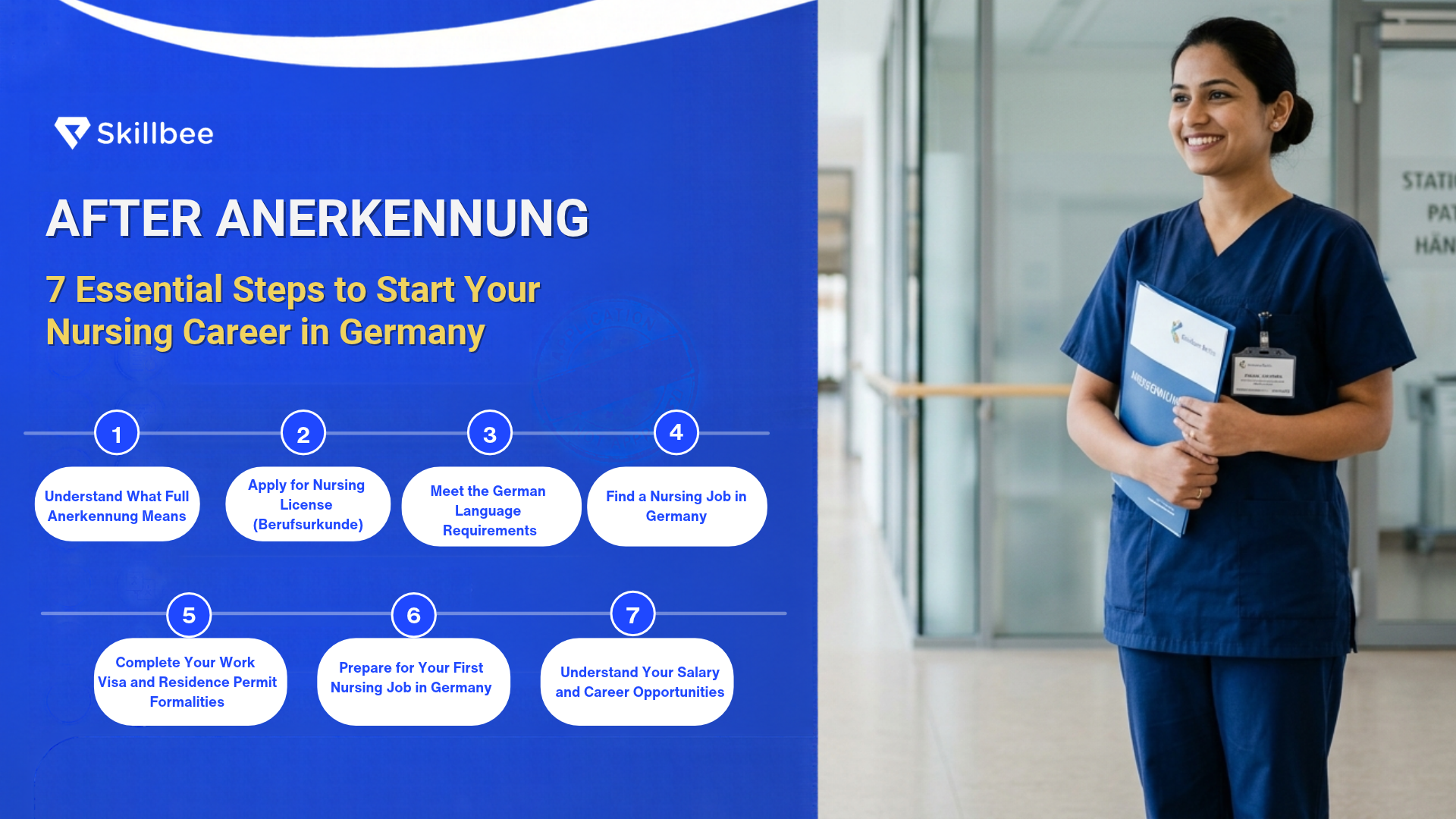
Receiving full Anerkennung is an important step for international nurses who want to build their career as a registered nurse in Germany. This recognition certificate confirms that their nursing qualification is equivalent to the German nursing qualification and that the nurses have met all necessary requirements for professional recognition.
However, receiving full recognition does not always mean nurses can start working immediately. They may still need to obtain their nursing licence in Germany, secure a suitable job, and complete the necessary work visa for nurses in Germany and residence permit formalities.
The next steps after receiving German nursing recognition include applying for the nursing licence, preparing for employment, completing immigration requirements, and understanding the responsibilities of working as a registered nurse in Germany. Knowing what to do after Anerkennung in Germany can help nurses plan their transition and begin their professional journey with greater confidence.
Understand What Full Anerkennung Means

Full Anerkennung confirms that the nurse’s nursing qualification from their home country is equivalent to the German nursing qualification. This means that the competent authority has assessed the nurse’s education and found that it meets all the required standards for professional recognition to work as a registered nurse in Germany.
For Indian nurses navigating German nursing recognition, this means that the authority has found no such differences that require additional compensatory training or a knowledge examination. The nurse’s qualification has been recognised as equivalent to German standards for nursing professionals.
Once Indian nurses receive a positive recognition decision, which is the Anerkennungsbescheid, it is important for them to understand what the document allows them to do after Anerkennung in Germany and what requirements may still apply.
There are three more important things that Indian nurses must understand:
- Recognition of your own qualification: Your Indian nursing education has been assessed through the process of German nursing recognition and is accepted as equivalent to the relevant German qualification.
- Professional authorisation: You must also meet the applicable requirements for permission to use the protected professional title of Pflegefachfrau (for women) or Pflegefachmann (for men). The Berufsurkunde (professional certificate) is the official document confirming this nursing licence in Germany.
- Employment eligibility: German nursing recognition does not automatically provide a job, a work visa for nurses in Germany, or a residence permit. This process involves separate employment and immigration procedures.
Indian nurses should also keep their recognition notice safe after Anerkennung in Germany because employers and relevant authorities may ask for it during recruitment, immigration, or the process of issuing a nursing licence in Germany.
Apply for Nursing License (Berufsurkunde)

After receiving full recognition (Anerkennung), the next step for nurses is to obtain their professional authorisation to use the protected nursing title and practice as a registered nurse in Germany. This authorisation is documented through the Berufsurkunde, which serves as the official nursing licence in Germany and confirms that internationally trained nurses are legally entitled to use the relevant professional title, such as Pflegefachfrau (for women) or Pflegefachmann (for men).
The nursing licence in Germany is issued by the competent authority in the German federal state where the nurses are applying. Although a nurse’s qualifications have already been recognised under German nursing recognition, the authority may need to verify that these internationally trained nurses meet the remaining requirements for professional practice after Anerkennung in Germany.
Common requirements that nurses should make sure of for obtaining Berufsurkunde include:
- Recognition notice: Your positive Anerkennungsbescheid (German recognition notice) confirming your nursing recognition in Germany.
- German language proficiency: Proof of the required German language level, generally B2, if it has not already been accepted during the recognition process
- Medical fitness: A medical certificate confirming that you are physically and mentally fit to practice as a registered nurse in Germany.
- Personal suitability: A certificate of good conduct or other relevant documents demonstrating that you are suitable to work in the nursing profession.
- Identity Documents: A valid passport and other identification documents requested by the authority.
The exact documents, application procedure, and validity requirements for obtaining a nursing licence in Germany may vary between federal states. Therefore, check the instructions provided by the competent licensing authority after Anerkennung in Germany before submitting your application.
Once the requirements are fulfilled and the nurse’s application is approved, nurses will receive their nursing licence in Germany (Berufsurkunde). Keep this document safe, as nurses must present it to future employers as proof of their professional authorisation to practice as a registered nurse in Germany.
Meet the German Language Requirements

Having German language proficiency is most important for foreign nurses working as registered nurses in Germany. Even after Anerkennung in Germany, nurses need to communicate confidently with patients, doctors, colleagues, and other healthcare professionals.
In nursing, language skills are not limited to everyday conversations. A registered nurse in Germany must understand medical instructions, explain treatment procedures, document patient information, and respond appropriately to patient needs.
Here are some important areas to focus on:
- B2 German proficiency: B2 is generally the required language level for internationally trained nurses seeking professional authorisation and a nursing licence in Germany. However, exact requirements depend on the competent authority issuing the German nursing recognition and licensing documents.
- Medical and nursing vocabulary: Nurses must learn commonly used German terms related to patient care, medications, symptoms, medical equipment, and nursing procedures.
- Patient communication: Practice explaining care routines, asking patients about their symptoms, and understanding their concerns.
- Clinical documentation: Become familiar with writing patient reports, recording vital signs, and documenting nursing activities in German as a registered nurse in Germany.
- Workplace communication: Learn how to participate in shift handovers, communicate with doctors, and coordinate with other members of the healthcare team.
How can you improve your German before starting work?
Regular speaking practice, listening to German conversations, and learning nursing-related vocabulary can make the transition easier after Anerkennung in Germany. You can also practise common workplace situations, such as patient handovers and discussions about treatment plans.
Obtaining a language certificate is an essential requirement for a nursing licence in Germany, but being able to use German confidently in everyday nursing situations will help you adjust to your role as a registered nurse in Germany.
Find a Nursing Job in Germany

Once you have completed the necessary German nursing recognition and nursing licence in Germany requirements, the next step is finding a suitable position as a registered nurse in Germany. With your qualifications recognised after Anerkennung in Germany, you can apply for positions that match your education, experience, and professional interests.
Opportunities for a registered nurse in Germany exist across different healthcare settings, including public and private hospitals, nursing homes, rehabilitation centres, and long-term care facilities.
Here are some important steps to follow when searching for a nursing job:
- Prepare your CV: Create an updated CV in German, highlighting your nursing qualifications, clinical experience, specialisations, language proficiency, and German nursing recognition status.
- Explore job opportunities: Look for vacancies for a registered nurse in Germany through hospital websites, healthcare recruitment agencies, official job portals, and verified employers.
- Prepare your application: Keep your recognition notice, nursing licence in Germany (Berufsurkunde, if issued), educational certificates, experience letters, and language certificates ready.
- Prepare for interviews: Be ready to discuss your previous nursing experience, patient-care responsibilities, clinical knowledge, and reasons for working as a registered nurse in Germany.
- Evaluate job offers: Check the employer’s reputation, job responsibilities, salary, working hours, shift arrangements, probation period, and conditions related to securing a work visa for nurses in Germany before accepting an offer.
What Should You Check Before Accepting a Nursing Job?
Before signing an employment contract after Anerkennung in Germany, make sure you understand:
- Whether the position is for a fully qualified registered nurse in Germany.
- Your expected working hours and shift schedule.
- Your gross monthly salary and additional allowances.
- Paid leave, social insurance, and employment benefits.
- Accommodation or relocation support, if offered.
- Probation period and notice period.
A suitable job offer is a vital step toward applying for a work visa for nurses in Germany and establishing your career. Take time to understand the employment conditions and ensure that the position matches your Germany nursing recognition status.
Complete Your Work Visa and Residence Permit Formalities

After securing a job after Anerkennung in Germany, the next step is completing the immigration formalities required to live and work as a registered nurse in Germany. Indian nurses who are not already authorised to work in Germany generally need an appropriate national work visa for nurses in Germany and a residence permit.
Since nursing is a regulated profession, your Germany nursing recognition, nursing licence in Germany, and employment details are critical parts of obtaining a work visa for nurses in Germany.
Main steps involved in securing your visa and residence permit:
- Check the appropriate visa category: Nurses with full Germany nursing recognition and a qualified job offer may be eligible for a work visa for nurses in Germany under Section 18a of the German Residence Act (residence permit for qualified professionals).
- Prepare your documents: Common documents for a work visa for nurses in Germany include a valid passport, employment contract, proof of German nursing recognition, nursing licence in Germany where required, health insurance, and completed visa application forms.
- Submit your visa application: Apply for the work visa for nurses in Germany through the German mission responsible for your place of residence in India.
- Complete additional formalities: Provide biometric information, attend an appointment, or submit additional documents requested by the visa authorities for your work visa for nurses in Germany.
- Understand your residence permit: After arriving and receiving Anerkennung in Germany, follow local registration procedures to finalize your residence permit as a registered nurse in Germany.
Full Germany nursing recognition does not automatically grant permission to enter or work. Your work visa for nurses in Germany and residence status must explicitly allow your intended employment as a registered nurse in Germany. Always check the latest instructions from the German Embassy in India before making travel arrangements.
Prepare for Your First Nursing Job in Germany

Getting a nursing job in Germany is an important achievement, but adjusting to a new healthcare system and workplace is another part of the journey. Even with full Anerkennung and the required professional authorisation, you may need time to become familiar with German hospital procedures, nursing practices and workplace expectations.
Before joining, take some time to understand how nursing responsibilities are organised in your new workplace.
Here are some areas to prepare for before your first day:
- Understand workplace procedures: Familiarise yourself with hospital policies, patient safety protocols, hygiene standards, and emergency procedures.
- Learn nursing documentation: German healthcare facilities follow structured documentation practices. Understand how patient records, medication administration, and nursing reports are maintained.
- Prepare for shift duties: Learn how shift handovers work, how patient responsibilities are assigned, and how nurses coordinate care during different shifts.
- Understand patient care practices: Become familiar with German standards for patient assessment, medication management, wound care, and infection prevention.
- Adjust to workplace communication: Professional communication with doctors, senior nurses, patients, and their families is important for effective teamwork.
- Complete employer orientation: Participate in the induction or onboarding programme offered by your hospital or care facility.
How Is Nursing in Germany Different from India?
Although the fundamental principles of nursing remain the same, workplace practices may differ. German healthcare facilities often place strong emphasis on structured documentation, patient independence, privacy, professional accountability, and clear communication.
For Indian nurses, adapting to these differences can take some time. Asking questions, learning from experienced colleagues, and actively participating in workplace orientation can make the transition easier.
Your first few weeks should be an opportunity to understand the workplace, build confidence, and become comfortable with your professional responsibilities.
Understand Your Salary and Career Opportunities

After completing your recognition, obtaining the necessary professional authorisation, and starting work, it is important to understand your earning potential and long-term career opportunities in Germany.
Registered nurses in Germany receive salaries based on several factors, including their employer, work location, professional experience, responsibilities, and applicable collective agreements. Public hospitals and some larger healthcare facilities follow structured pay scales, while private employers may offer different salary arrangements.
Here are some important aspects to understand:
- Monthly salary: Your gross salary depends on your employment contract, experience, and the applicable pay structure.
- Shift allowances: Night shifts, weekend duties and public holiday work may come with additional payments, depending on your contract or collective agreement.
- Paid leave: Employees are entitled to paid annual leave under German employment law.
- Social security benefits: Employees generally contribute to health insurance, pension insurance, unemployment insurance and long-term care insurance.
- Professional development: Nurses can pursue additional training and specialisations in areas such as intensive care, emergency nursing, geriatrics and oncology.
- Career progression: With experience and further qualifications, nurses can explore senior nursing positions, specialist roles and leadership opportunities.
What Career Opportunities Are Available After Anerkennung?
Full recognition allows you to pursue qualified nursing positions that match your professional authorisation. As you gain experience in Germany, you can explore different healthcare settings and develop expertise in specific areas of patient care.
You may also pursue further education to become a specialist nurse, practice instructor or nursing manager, depending on the qualifications and requirements for each role.
Building a nursing career in Germany is a gradual process. Along with your initial employment, continuous learning, practical experience and language development can help you explore better professional opportunities over time.
Conclusion
Receiving full Anerkennung is a major milestone for Indian nurses planning to build their careers in Germany. However, it is only one part of the journey towards professional employment. Nurses must also complete the necessary licensing formalities, meet German language requirements, secure a suitable job, and obtain the appropriate work visa and residence permit.
Preparing for the German healthcare environment is equally important. Understanding workplace practices, improving professional communication, and becoming familiar with patient-care procedures can make the transition smoother.
Skillbee supports aspiring nurses throughout their journey towards building a nursing career in Germany. From German language training and interview preparation to documentation guidance, visa and work permit assistance, and relocation support, Skillbee helps candidates understand and prepare for the different stages of the process.
With the right preparation, professional guidance, and a clear understanding of the requirements, Indian nurses can move forward with confidence and explore long-term career opportunities in Germany.
 +91 73 6009 6009 (India)
 contact@skillbee.com
Leave a Reply