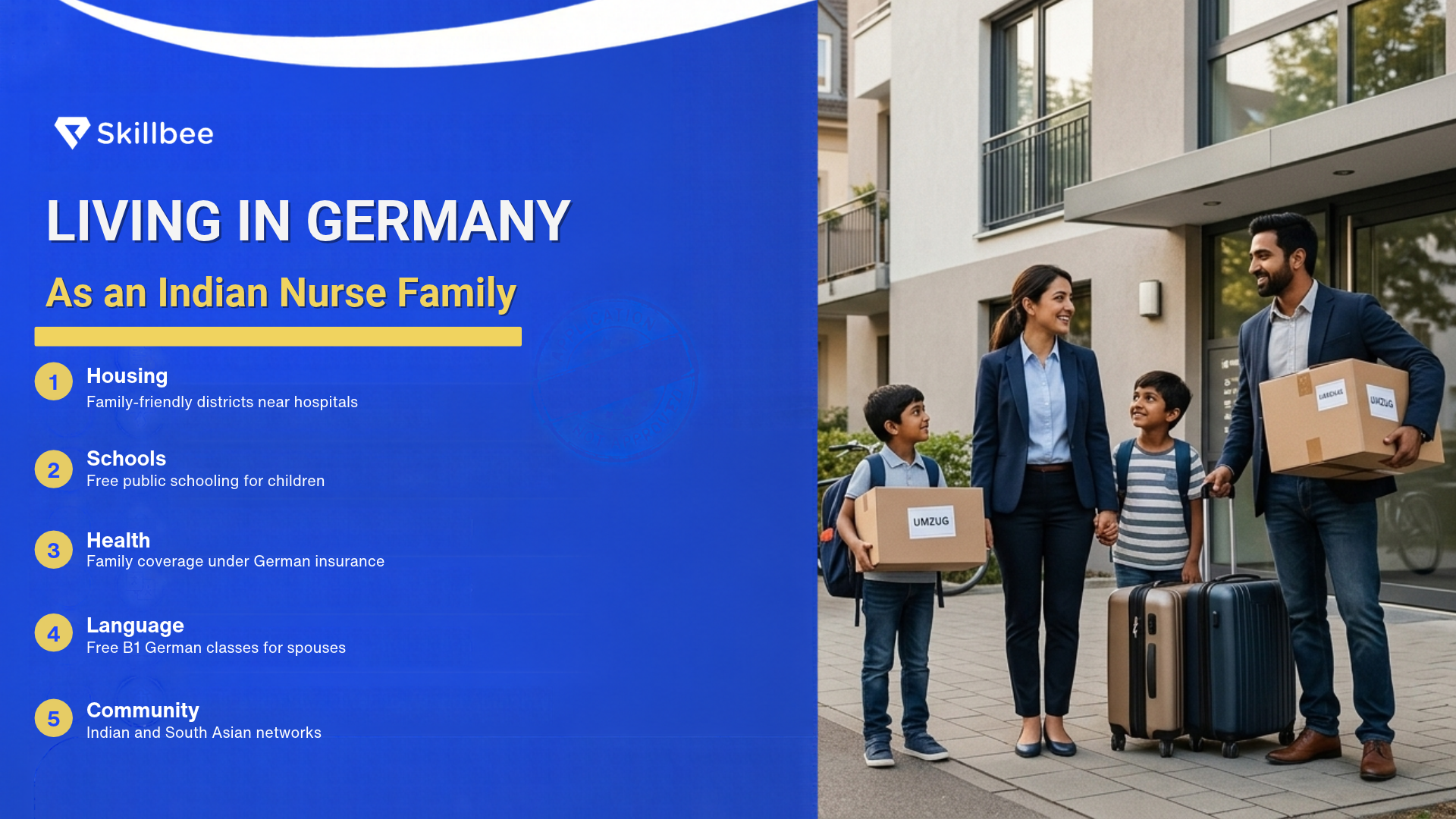
Moving to Germany as an Indian nurse is one of the most transformative decisions a family can make. It is driven by ambition, sacrifice, and a desire to build a better future for both the nursing professional and the family members they support in India. While much has been written about nursing careers in Germany, the experiences of Indian families settling in Germany deserve equal attention.
For many nurses, living in Germany as an Indian nurse family means more than finding a stable job abroad. It means creating a home in a new country, bringing loved ones together, giving children access to quality education, and building a financially secure future.
This guide to life in Germany for Indian nurse families focuses on the experiences of the entire household. It explores how Indian nurses can bring their families to Germany through the Family Reunion Visa, how spouses and children can adapt to German society, and how families can find Indian communities, grocery stores, and cultural activities.
From understanding the German school system for Indian children to managing healthcare, finances, and travel between Germany and India, this article provides a comprehensive guide to family life in Germany for Indians.
Introduction to living in Germany as an Indian nurse family

Germany has become a popular destination for Indian nurses and, through them, for their families. Over the past decade, the country’s ageing population has created a structural shortage of qualified nursing professionals. Indian nurses have contributed significantly to meeting this demand through their qualifications, dedication, and clinical experience.
Today, thousands of Indian nurses living in Germany are building careers while bringing their families across to join them. These families are enrolling their children in German schools, finding Indian grocery stores, joining cultural associations, and establishing new lives in cities such as Berlin, Munich, Frankfurt, Hamburg, and Stuttgart.
For families, living in Germany as an Indian nurse family can offer several advantages. These include access to public education, a structured healthcare system, employment protections, and opportunities to explore other European countries. However, the experience also involves practical adjustments, such as learning German, understanding local regulations, managing expenses, and adapting to a different lifestyle.
The appeal of life in Germany for Indian nurses and their families includes stable employment, public education, healthcare coverage, strong labour protections, and opportunities to explore other European countries. However, families must also prepare for differences in language, culture, weather, and everyday expenses.
Germany offers Indian nurses the opportunity to build a long-term future, but successful settlement requires preparation beyond professional recognition and employment.
| Key Statistic | Data |
| Indian nurses working in Germany (2025) | Approximately 16,600 (2025) |
| Indians living in Germany (Dec 2024) | 277,455 (December 2024) |
| The largest Indian city community | Berlin – 45,189 |
| Average monthly nurse salary (net) | €1,800 – €2,500 |
| Average money sent home per month | €300 – €600 |
| Family reunion visa processing | This varies by application and location. |
Understanding the financial and social environment is an important first step towards living in Germany as an Indian nurse family. The following sections explain the major things families should know before and after relocation.

Family Reunion Visa

For most Indian nurses in Germany, the most emotionally challenging milestone after settling in the country is the moment their family joins them. Germany’s Family Reunion Visa, formally known as the Familienzusammenführungsvisum, is the legal pathway that makes this possible, allowing a nurse’s spouse and other family members to relocate and build a shared life in Germany.
Understanding this process early on, candidates need to plan for it patiently and also prepare the right documents, which will make the difference between a smooth reunion and a stressful, prolonged wait. The process can take anywhere from six months to over a year, but with proper preparation, the waiting period is predictable and manageable.
For families planning on living in Germany as an Indian nurse family, the Family Reunion Visa is an important part of the relocation process. However, the requirements are not identical for every applicant. They can depend on the nurse’s residence status, employment, income, accommodation, and the relationship of the family member applying.
The process can take several months. The actual waiting period depends on appointment availability, document checks, and the authorities involved. A timeline of six to twelve months should therefore be treated as an estimate, not a guarantee.
Who Is Eligible?
If the candidate is a legally married spouse and their children are unmarried and under 18, they are eligible for the family reunification visa. It is very important to understand that parents, in-laws, siblings, or other relatives cannot be covered under this scheme; they would require separate, or even more complex, visa routes. The nurses who are already working in Germany are the sponsors for their spouse or their children’s application for reunification, and the strength of the application rests heavily on demonstrating stable employment, adequate housing, and sufficient income to support the entire family without accessing German social welfare.
One of the most frequently overlooked requirements is the language requirement in the country; the candidate’s spouse is required to demonstrate an A1 level of proficiency in German before the visa can be granted to them. This means that the candidate’s spouse must complete the basic language test, typically the Goethe-Zertifikat 1, at any recognised examination centres in India. Children below the age of 16 are exempt from these language requirements, and there are also exemptions for spouses joining holders of an EU Blue Card, but it is also wise to clarify this with the German consulate in advance.
The Application Process – Step by Step
- Start with German language preparation: The spouse should start preparing for the A1 German language examination as early as possible. This is an important step when bringing the family to Germany as an Indian nurse.
- Collect Documents in Germany: The nurse should prepare the employment contract, recent payslips, tenancy agreements, health insurance confirmation, and residence registration certificate.
- Prepare Documents in India: Family members need valid passports, marriage and birth certificates (the certificates should be translated into German), biometric photographs, and the required language certificate (A1 preferred for spouse).
- Book the Visa appointment: After the collection of all the necessary documents, the spouse should book an appointment at the German embassy or at one of the Consulates General in India, which are located in Delhi, Mumbai, Chennai, Kolkata, and Bangalore. The appointment slots fill up very fast and often weeks or months in advance, so book as early as possible.
- Attend the Appointment: Now, after the appointment is fixed, the spouse is required to attend the visa interview. Both spouses may need to appear, and their family members in India must attend the appointment personally with all original documents. Visa processing will begin after the appointment, which typically takes between 6 and 12 weeks.
- Complete Residency Formalities: Then, the spouse will receive the residence permit. Under the EU Blue Card rules, the spouse who will join a Blue Card holder has the right to take full-time employment in Germany without needing a separate work permit.
Nurses should start the A1 Language course process for their spouses the moment they arrive in Germany and confirm their job. The language exam is the single most time-consuming step in the entire process and can be completed in India well before the embassy appointment. The earlier the spouse or the family member begins, the sooner the family can join the candidate.
Quick Note: Nurses should start the A1 Language course process for their spouses the moment they arrive in Germany and confirm their job. The language exam is the single most time-consuming step in the entire process and can be completed in India well before the embassy appointment. The earlier the spouse or the family member begins, the sooner the family can join the candidate.
| Document Required | Who Provides It |
| Valid passport (6+ months validity) | Family member in India |
| A1 German language certificate (spouse only) | Goethe Institut or recognised exam centre |
| Marriage certificate – apostilled, translated into German | Indian registry office + sworn translator |
| Children’s birth certificates – apostilled | Indian registry office |
| Proof of accommodation in Germany | Nurse (tenancy agreement showing address and size) |
| Proof of sufficient income (3 pay slips + employment contract) | Nurse in Germany |
| Health insurance confirmation letter | Nurse’s health insurance provider (Krankenkasse) |
| Anmeldung – residence registration certificate | Nurse (obtained from the local Bürgeramt in Germany) |
| Biometric passport photographs | Family member in India |
Indian Communities by City

For Indian families living in Germany, community is not a luxury; it is support. The first few months in a foreign country or new country are sometimes emotionally demanding, and the presence of people who speak and understand the same language, culture, and food, and who can also understand the experience of being far from home makes an enormous difference. The good news is that the Indian community in Germany has grown significantly over the years, with over 277000 Indian nationals who are now residents in the country itself, and it is also deeply organised, warm, and welcoming to the newcomers.
The major German city has developed its own Indian ecosystem over the years: WhatsApp groups where families share apartment tips and also hospital recommendations, cultural associations that will organise festive meals and evenings filled with Indian cultural festivals, religious places, and Indian restaurants where the candidate can have a taste of their home country. When a candidate first arrives, he/she should search the city name alongside “Indian community Germany”. On Social media platforms like Facebook and Instagram, candidates can connect to the Indian community quite easily and can connect with them within a few hours.
| City | Indian Population (2024–25) | Key Community Notes |
| Berlin | 45,189 | Germany’s largest Indian community. Multiple Hindu temples, active cultural associations, Indian film festivals, and one of the best restaurant scenes. |
| Munich | 17,549 | Strong professional and healthcare community. Popular with South Indian nurses. Indian stores near Hauptbahnhof. Regular cultural events. |
| Frankfurt | 11,393 | Financial hub with large Gujarati and Telugu communities. Active Indian associations. Indian events throughout the year. |
| Hamburg | 9,864 | Warm and growing community. Bombay Palace Supermarket in Altona is a landmark. Regular community gatherings. |
| Stuttgart | 6,111 | Growing community, particularly among IT and healthcare professionals. Good Indian restaurant options and cultural groups. |
| Düsseldorf | 4,800+ | Notable South Indian community. Excellent restaurant scene, including authentic South Indian options. |
| Cologne | 4,200+ | Active Indian cultural associations. Navratri and Diwali celebrations are well-attended and vibrant. |
The Indian community in Berlin offers a diverse social environment with cultural activities, restaurants, and community events. Munich attracts many Indian professionals, while Frankfurt has a strong presence of regional Indian associations.
For nurses and their families, connecting with other Indian nurses living in Germany can be particularly helpful. They may share practical advice about finding accommodation, choosing schools, and understanding workplace expectations.
Finding an Indian Grocery Store and Restaurants

The question every Indian family asks before moving to a foreign country like Germany: “Will we find our food there?
This question has a deeply reassuring answer. Indian grocery stores in Germany have grown enormously over the past decade, which is driven by a large and steadily expanding Indian diaspora. From fresh curry leaves to Indian spices, from Indian basmati rice to kokum, from ready-made mixes to even Indian style pickles, the candidate can find most of these things or the things they need, and what they cannot find in the local shops, they can easily order online and have them delivered to their residence.
For Indian families, living in Germany as an Indian nurse family does not mean giving up familiar meals. It may take some time to discover the right shops, compare prices, and find regional ingredients, but there are several ways to manage grocery shopping.
City by City Store Guide
In Berlin, the most comprehensive Indian grocery stores are clustered around Wrangelkiez in Kreuzberg and near Hermannplatz, with several shops offering both North and South Indian products. Spice Village and Asia Pavillon are well-regarded. In Munich, stores concentrate near the Hauptbahnhof area, with Sai Supermarket being a consistent favourite among the Indian community. Frankfurt’s Indian grocery scene is active around Konstablerwache and the Sachsenhausen area. Hamburg is home to what many consider Germany’s best Indian supermarket, the Bombay Palace Supermarket in Altona, a treasure trove that stocks even hard-to-find South Indian ingredients. Stuttgart’s selection is smaller but growing; for specific items, residents combine local Asian stores with online ordering.
In Berlin, the most comprehensive Indian grocery stores are located around Wrangelkiez in Kreuzberg and near Hermannplatz, with several shops offering both North and South Indian products. Spice Village and Asia Pavilion are registered stores. In Munich, stores are located near the Hauptbahnhof area, with Sai Supermarket, which is a consistent favourite among the Indian community. Frankfurt’s Indian grocery scene is active around Konstablerwache and the Sachsenhausen area. Hamburg is home to what many consider Germany’s best Indian supermarket, the Bombay Place in Altona. This is a treasure for many South Indian communities, as many south indian food ingredients that are hard to find in Germany can be available here. Stuttgart’s selection is smaller but growing; for specific items, residents combine local Asian stores with online ordering.
Online Indian Grocery
For families who are staying in smaller cities or towns in Germany, it is quite common for nurses to be employed by smaller regional hospitals. Online Indian grocery delivery is genuinely life-changing. The platform Dookan (eu.dookan.com) is Germany’s largest online Indian grocery store, shipping across the entire country with a vast range covering every regional cuisine. Amazon.de carries an increasingly wide range of Indian brands, including MTR, Priya, Aachi, and Eastern.
Indian Restaurants
Indian restaurants are another way for families to enjoy familiar food and explore different regional cuisines. Major cities such as Berlin, Munich, Frankfurt, Hamburg and Stuttgart have restaurants serving North Indian, South Indian and other Indian dishes.
Berlin has a particularly varied restaurant scene, with options ranging from casual eateries serving Punjabi food to restaurants specialising in South Indian cuisine. Other major cities also have Indian restaurants, while smaller university towns may have a limited selection.
Families who are living in Germany as an Indian nurse family can use local restaurant directories, Google Maps, and community recommendations to discover places that suit their food preferences and budget.
Schools for the Children

Education is one of the most important considerations for Indian parents moving to Germany. Parents naturally want to understand how their children will adjust, whether they can join school without knowing German and what the education system expects from families.
Germany has a publicly funded school system, and children can receive language support when they arrive without sufficient German skills. However, the structure of schooling, enrolment procedures and age requirements can vary between federal states.
For Indian parents, understanding the school system before relocation can make living in Germany as an Indian nurse family easier. It also helps families prepare the necessary documents and make informed decisions about their children’s education.
| Education Level | Age Group | German Name | Key Notes for Indian Families |
| Crèche / Nursery | 0–3 years | Krippe | Optional but beneficial. Monthly fee applies (income-based). Waitlists can be long; register early after arrival. |
| Kindergarten | 3–6 years | Kindergarten / Kita | Compulsory in most states from age 4. Mostly free or heavily subsidised. Best early German immersion opportunity. |
| Primary School | 6–10 years | Grundschule | Assigned based on home address. All instruction in German. Schools offer German language support classes for new arrivals. |
| Secondary School | 10–18 years | Gymnasium / Realschule / Hauptschule | Streaming based on primary school performance. Gymnasium leads to university (Abitur). Parents can request placement. |
The Enrolment Process
Candidates need to contact the local Schulamt, the district school authority, and visit the nearest primary school directly to enrol their child in a German Grundschule. They are required to carry all the necessary documents, which typically include the child’s birth certificate, vaccination records, and proof of residence (Anmeldung), and the parents’ German residence permits. Most schools with experience with international families are well-prepared for this process. Enrollment typically takes place in the autumn before the school year.
An important provision that Indian parents should know about is that German schools are legally required to offer preparatory language classes, known as Vorbereitungsklassen or DaZ classes (Deutsch asl Zweitsprache – German as a Second Language). These classes are specifically designed for children who arrive with no knowledge of the German language, and they are held alongside regular schooling so that children can adapt easily. Within six to twelve months, the vast majority of Indian children transition fully into regular German classrooms.
How Can Indian Children Adapts
Children often learn a new language through everyday interaction. School activities, friendships, sports, playground conversations and classroom lessons provide regular opportunities to practise German.
Younger children may find it easier to pick up conversational language because they spend more time interacting with other children. Older students may need additional support, particularly when they are expected to understand academic subjects in German.
Parents can support the transition by:
- Encouraging children to participate in school activities.
- Reading simple German books together.
- Practising everyday German phrases at home.
- Maintaining communication with teachers.
- Joining sports clubs or other activities.
- Giving children time to adjust without comparing their progress with others.
Children may also become more comfortable with German before their parents do. This can help the entire household with everyday interactions, although parents should continue learning the language themselves.
For families planning living in Germany as an Indian nurse family, children’s education can become one of the most rewarding parts of settling in the country. They get the opportunity to learn a new language, experience a different education system, and grow up with exposure to more than one culture.

Language – Learning German as a family

Language is the central thread running through every aspect of life in Germany: professional success, social integration, schooling, healthcare, and also the simple everyday interactions that can make the candidate and their families feel at home. For Indian families, who are approaching language learning as a family project rather than an individual responsibility, it makes the journey significantly more manageable and, honestly, a lot more fun.
For the nurse, B2 German is the professional entry requirement, the level at which you can communicate effectively with patients, colleagues, and hospital administration. This is typically achieved through intensive language courses, often supported by the recruitment agency or the employing hospital. But for the spouse and children, the language journey looks different. A spouse needs an A1 to obtain the family reunion visa, then ideally advances to B1 or B2 over the following one to two years if they wish to work in Germany. Children, as discussed in the previous section, typically acquire German naturally and rapidly through school immersion.
For Indian families settling in Germany, learning German as a household can make everyday tasks easier, from speaking with teachers to attending medical appointments and communicating with neighbours.
| Family Member | Required Level | Primary Purpose | Typical Timeline |
| Nurse | B2 (professional) | Hospital work, patient care, ward communication | Before or shortly after arrival in Germany |
| Spouse (for visa) | A1 | Satisfying the family reunion visa language requirement | 2–4 months of preparation in India |
| Spouse (for employment) | B1–B2 | Job applications and workplace communication in Germany | 12–24 months after arrival in Germany |
| Children (primary school) | Beginner to fluent | School integration, friendships, and daily life | 6–12 months via the school DaZ programme |
| Children (Kita) | None required | Social integration, play-based German acquisition | Begins naturally within weeks of starting |
Language Learning Options for Spouses
Spouses who want to continue learning German after arriving in Germany can explore several affordable options.
Volkshochschule (VHS)
The Volkshochschule is a public adult education institution available in many German cities and towns. It offers language courses at different levels, including beginner and intermediate German.
Course fees vary by location, level, and duration. Some courses may cost around €80–€150 for a course or semester, but families should check the current fee structure with their local VHS.
BAMF Integration Courses
The German Federal Office for Migration and Refugees (BAMF) supports integration courses for eligible migrants. These courses generally combine German language instruction with information about German society, laws, and everyday life.
A standard integration course can include approximately 600 hours of language instruction, followed by an orientation course. Eligibility, fees and possible exemptions or subsidies depend on the individual’s residence status.
Online Learning and Daily Practice
Online courses, language-learning apps and conversation groups can help spouses practise outside the classroom. Simple daily activities, such as shopping, speaking to neighbours and attending appointments, also provide opportunities to improve German.
Make Language Learning a Family Activity
Families do not need to study German in exactly the same way. The nurse may focus on medical terminology and professional communication, while the spouse may concentrate on everyday conversations and employment-related vocabulary. Children can practise through schoolwork, books and activities.
A shared routine can help everyone stay motivated. For example, families can practise new words during meals, watch German children’s programmes together or set aside a few minutes each day for conversation.
Language learning is a gradual process. Being patient with one another can make a considerable difference to living in Germany as an Indian nurse family.
Cultural Adjustment – Life in Germany

Germany and India are two of the world’s great civilisations, each with deep traditions, strong values, and distinctive ways of organising daily life. Moving between them is not a question of one being better or worse; it is a question of understanding difference, preparing for it, and approaching it with curiosity rather than resistance. Indian families who thrive in Germany are almost universally those who engage with German culture actively, rather than those who simply wait to feel at home.
The experience of living in Germany as an Indian nurse family becomes easier when family members remain open to learning about German customs while continuing to enjoy their own traditions.
Punctuality Is Non-Negotiable
Germans treat time with an almost reverential seriousness. Being five minutes late to a doctor’s appointment, a school meeting, a work shift, or even a casual dinner invitation is considered genuinely rude and will be noticed. For Indian families accustomed to a more fluid relationship with time, where ‘I am coming’ can mean anywhere from five minutes to two hours, this requires a real adjustment. Build the habit of arriving on time, or even a few minutes early. Set reminders, plan for delays, and err on the side of punctuality. This single cultural adaptation will smooth more professional and social interactions in Germany than almost anything else.
Direct Communication
German communication is famously direct. When a German colleague tells you that your work needs improvement, or when a German doctor gives you a frank assessment, or when a German neighbour knocks on your door to mention that your child was making noise, they are not being rude; they are being direct, which in German culture is considered respectful and honest. For Indian families more accustomed to indirect, context-layered communication where the real message is often wrapped in softening language, this directness can initially feel harsh or even offensive. It is not. Recognising this cultural difference early saves a great deal of unnecessary emotional stress.
Privacy, Slow Friendships, and Community
Germans value privacy deeply. Your neighbours may not greet you warmly when you move in, may not introduce themselves for weeks or months, and may seem cool or indifferent initially. This is not hostility; it is the German way of respecting personal boundaries. German friendships develop slowly, but once formed, they tend to be deep, reliable, and genuinely caring. Indian families often find that once they break through this initial reserve, often through shared school activities, workplace relationships, or neighbourhood events, their German friendships become some of the most valued of their lives.
Rules, Paperwork, and Bureaucracy
Germany runs on documentation. Every address change must be registered (Anmeldung) within 14 days at the local Einwohnermeldeamt. Every official letter from a government authority must be taken seriously and responded to promptly; ignoring correspondence in Germany has real consequences. Waste separation is legally required and strictly observed: paper, plastics, glass, organic waste, and residual waste each have their own coloured bins. Quiet hours (Ruhezeit), typically from 10 PM to 6 AM and all day Sunday, are legally enforced, and violating them repeatedly can result in formal complaints. Understanding and respecting these systems is not optional; it is part of living in Germany, and doing so smoothly signals respect for the society you have joined.
Sunday Closures and Weekly Rhythms
One of the first practical shocks for Indian families arriving in Germany, and it is genuinely shocking the first time it happens, is discovering that almost everything is closed on Sundays in Germany. Supermarkets, pharmacies, clothing shops, and other stores, banks, government offices, and most businesses observe Sunday as a legally mandated day of rest under the Ladenschlussgesetz, which means the shop closing law. If the candidate runs out of any necessary items on Sunday, the options are limited to a petrol station or any shop inside the train station.
This takes real adjustment for Indian families who are used to round-the-clock availability, but this is genuinely appreciated by many families there. Germans do their weekly shopping on Friday evening or on Saturdays, and Sunday is reserved for spending time with families and resting. After the initial adjustment, many Indian families find that they actually enjoy the enforced pause that Sunday brings.
What Remains Open on Sundays
Although most retail shops are closed, families still have access to several services and activities.
- Restaurants and cafés: Many restaurants, cafés and bakeries remain open and are popular for Sunday meals and brunch.
- Petrol stations: Many petrol stations sell basic food, drinks and household essentials.
- Emergency pharmacies: Duty pharmacies, known as Notdienstapotheken, provide access to essential medicines. Information about the nearest duty pharmacy is generally available online and displayed at local pharmacies.
- Hospitals and emergency services: Emergency medical services continue to operate.
- Airport and railway station shops: Certain shops in major transport hubs may remain open under specific rules.
- Tourist attractions: Many museums, seasonal attractions, Christmas markets and summer events operate on Sundays.
Public Holidays in Germany
Germany has several public holidays each year. The exact number depends on the federal state because some holidays are observed nationally while others apply only in particular states.
On public holidays, many shops and offices follow Sunday-style closing arrangements. Families should check the local holiday calendar before planning shopping, appointments or administrative visits.
Planning ahead can make weekly routines easier and prevent unnecessary inconvenience for those living in Germany as an Indian nurse family.
Surviving and Enjoying Winters in Germany

Nothing quite prepares the family from India, or any tropical or subtropical part of India, for the reality of German Winter. The cold is not just cold; it is accompanied by a profound reduction in daylight hours, grey skies that can persist for weeks without break, and a bone-deep chill that requires the complete rethinking of how the candidates and family are supposed to dress, move, and manage daily life. In December in northern Germany, the sun sets before 4 pm. In Bavaria, the temperature often drops below -15°C. Heating bills spike. Roads ice over. And the transition from India’s warmth to this reality, if you are not prepared, can be genuinely difficult.
The good news is that every challenge winter poses is entirely manageable with preparation, and Germany’s winters also carry genuine wonder: the fairy-tale beauty of snow-covered streets, the warmth and festivity of Christmas markets, the cosiness of evenings indoors with family, and the quiet magic of a landscape that looks completely different from anything you have known. Many Indian families who dread their first winter come out of it having discovered a new relationship with the cold and the season. Preparation is everything.
Clothing and Equipment
Before moving to Germany, families should plan for colder weather. Winter clothing available in India may not always be suitable for the temperatures and conditions experienced in Germany.
Some useful items include:
- Thermal innerwear.
- Fleece or woollen clothing.
- Warm winter jackets and overcoats.
- Insulated gloves and winter socks.
- Waterproof winter boots with good grip.
- Warm hats and scarves.
- Weather-appropriate clothing for children.
Parents should pay particular attention to children’s school clothing. Outdoor activities may continue during colder weather, depending on the school’s routine and conditions. Children need suitable layers so they can remain comfortable outside. It is also useful to invest in waterproof footwear and clothing for rainy or snowy days.
Health in Winters
Reduced daylight and colder weather can affect daily routines, physical activity and general well-being. Families should try to maintain regular outdoor activity whenever weather conditions allow, dress appropriately and keep their homes comfortably heated.
Vitamin D levels can also be a concern for some people during periods of limited sunlight. However, supplementation needs vary. Rather than starting a high-dose supplement automatically, family members should discuss testing and the appropriate dosage with a healthcare professional.
Seasonal Affective Disorder (SAD) is a recognised condition associated with seasonal changes and reduced daylight. Some people experience persistent low mood, tiredness or changes in sleep and motivation during winter.
If these symptoms continue or affect daily life, it is important to speak with a Hausarzt or another healthcare professional. Depending on the individual, treatment may include light therapy, counselling or medication.
Staying active, maintaining social connections and following a regular routine can also help families manage the winter months.
Quick Note: Seasonal Affective Disorder (SAD) – this is the form of depression that is triggered by reduced light exposure; it is recognised as a medical condition in Germany and affects a good number of people, including South Asian residents as well. If the candidate and family member experience persistent low mood, fatigue, or loss of motivation throughout the winter season, they should immediately speak to their Hausarzt. Treatment options for this include light therapy lamps, counselling, and medication.
| Month | Average Temperature | What to Expect |
| October | 8°C – 15°C | Autumn in full colour. Begin buying winter clothing. Evenings cool quickly. |
| November | 2°C – 8°C | Grey and cold. Christmas markets begin in late November whis is the genuine highlight of the winters. |
| December | -2°C – 4°C | Coldest and darkest month. Full winter clothing essential at all times. Festive and magical despite the cold. |
| January | -5°C – 2°C | Deep winter. Snow likely across most regions. Short days. Keep active and connected. |
| February | -3°C – 5°C | Still cold, but days begin lengthening noticeably. Spring feels closer. |
| March | 4°C – 12°C | Spring arrives. Trees blossom. Mood lifts visibly. Germany at its most beautiful. |
Families should check the weather forecast for their particular city because winters in Hamburg, Berlin, Munich and Stuttgart can feel quite different.
With proper preparation, winter does not have to become a barrier to living in Germany as an Indian nurse family. It can become another part of the experience of building a life in a new country.

Healthcare for the Family

Germany has an established healthcare system that provides access to medical services through statutory and private health insurance. For Indian nurses moving to Germany, understanding how health insurance works is essential, particularly when their spouse and children join them.
Many employed nurses are covered by statutory health insurance, known as Gesetzliche Krankenversicherung (GKV), if they meet the eligibility conditions. One important feature is Familienversicherung, which can allow eligible non-working spouses and children to receive coverage through the insured family member without paying a separate statutory contribution.
However, family coverage is subject to conditions. For example, a spouse’s income and insurance status can affect eligibility. Families should confirm their circumstances directly with their health insurance provider.
For those planning for living in Germany as an Indian nurse family, understanding health insurance before the family arrives can help avoid gaps in coverage.
How the German Healthcare System Works
For employees covered by statutory health insurance, contributions are generally calculated as a percentage of gross income. The standard contribution is shared between the employee and employer, with additional contribution rules applying.
The exact amount depends on the applicable contribution rates and the individual’s circumstances. It is therefore better to check the current rate with the chosen health insurance provider rather than rely on a fixed percentage.
Statutory health insurance generally provides access to a broad range of services, which can include:
- General practitioner consultations.
- Specialist treatment and referrals.
- Hospital treatment.
- Medically necessary prescription medicines.
- Maternity-related healthcare.
- Preventive check-ups.
- Certain dental treatments.
- Eligible mental healthcare services.
Registering with a Family Doctor
After settling in Germany, it is useful to find a local general practitioner, known as a Hausarzt. A Hausarzt can provide treatment for common illnesses, conduct routine check-ups, manage ongoing health concerns, and refer patients to specialists when required.
Families can search for a nearby practice through online directories, health insurance provider websites, or recommendations from local residents.
In cities with larger Indian communities, families may also find doctors who speak English or Indian languages. In smaller towns, language availability can differ between practices.
Learning basic German medical vocabulary can make appointments easier. It is also helpful to carry insurance details, previous medical records, and a list of current medicines when visiting a new doctor.
For Indian families living in Germany, understanding the healthcare system early can help them access medical services confidently and avoid confusion during emergencies.
Sending Money Home to India

Every Indian nurse who is working in Germany and are planning to work in Germany, providing financial support for family back in India is the step, why they made this move, which is for better life professionally, personally and financially. German nursing salaries, while modest relative to German living standards, translate meaningfully into Indian rupees, and the ability to regularly send €300 to €600 home every month can improve the financial situation back in India. The good news is that international money transfer from Germany to indian is much easier, faster, and affordable.
A generation ago, sending money abroad required bank visits, waiting for multiple days, and significant fees were charged. Today, with digital technology on the rise, digital transfer services process Germany-to-India remittance in minutes, with fees as low as 1 to 2 euros per transfer and exchange rates that are far more competitive than any bank’s published rate. The key is knowing which services to use and how to compare them, because rates and fees fluctuate and the best service one month may not be the best the next.
For families living in Germany as an Indian nurse family, it is useful to create a monthly budget that accounts for both expenses in Germany and financial commitments in India.
International money transfers have become easier with digital services. Several providers allow users to send money from Germany to India without visiting a bank branch. However, fees, exchange rates, and transfer times can change.
| Service | Typical Fee (€200 transfer) | Transfer Speed | Best For |
| Wise (formerly TransferWise) | €1.50 – €3.50 | Same day or next day | Best mid-market exchange rates; most popular among Indian nurses in Germany |
| Remitly | €0 – €3.99 | Minutes to 3 days | Fast express options; strong promotional rates for first transfer |
| ACE Money Transfer | Low fixed fee | Same day | Growing popularity in the Indian expat community; competitive rates |
| Money2India Europe (ICICI) | Low fee | 2–3 days | Trusted ICICI Bank brand; familiar and reassuring for Indian families |
| Western Union | Varies | Minutes | Widely available; slightly higher fees but useful for urgent transfers |
The single most useful tool for comparing transfer services is Monito (monito.com), which aggregates live rates and fees from all major providers and tells you, in real time, exactly which service will deliver the most rupees for your euros today. Bookmark it. Most experienced Indian nurses in Germany check Monito before each monthly transfer and have saved hundreds of euros per year simply by choosing the best service on any given day rather than defaulting to one provider out of habit.
Returning to India for Visits
Germany is where the nurses seek to build their future, but India is always home, and for most Indian nurse families, regular trips back to India are essential for them. Whether for major family events, for the annual festival season, or simply to reconnect with parents and siblings, the journey between Germany and India is one that most families make at least once a year.
The OCI Card – The Most Important Document
If the candidates and their family members have obtained German permanent residency or German citizenship, they will need an OCI (Overseas Citizenship of India) card, which means any indian family who has retained their Indian nationality will need this card for travelling to and within India. The OCI card functions effectively as a lifelong multiple-entry visa to India, granting the holder of the card the same rights as Indian citizens, which includes the right to live, work, study, and own non-agricultural property in India. It is issued by the Indian embassy in Berlin or the Consulate General in Munich or Frankfurt, and applications can be processed online through the Indian government’s OCI Portal.
There is one important renewal rule that catches many Indian families off guard: OCI cardholders under the age of 20 or over the age of 50 must have their OCI booklet re-issued every time they obtain a new passport. Failing to do this can cause complications at Indian airports, so set a reminder the moment you or your child gets a new passport. Since October 2025, India requires an e-arrival card for most foreign visitors entering the country, but Indian nationals and OCI cardholders are exempt from this requirement.
Planning the Trip
Flights between Germany and India are most affordable when booked a month in advance for regular travel and significantly more in advance for peak-season travel during summer (June to August) and the Christmas- New Year window (mid-December to early January). The most popular airlines for the route include Air India, Lufthansa, Emirates, Etihad, and Qatar Airways, with Frankfurt and Munich offering the most direct connections to major Indian cities. Factor in the OCI card renewal timeline, any medical kit candidate may need from Germany, and the potential health insurance implications of an extended stay when planning your trip.
For Indian nurses and their families in Germany, regular visits to India can help maintain family relationships and cultural connections while building a life abroad.
Why Skillbee is the Right Partner for the Candidate’s Journey to Germany

The journey from being a qualified nurse in India to building a settled, thriving life in Germany is not a short or simple one. It involves professional preparation, language acquisition, mountains of documentation, navigating foreign bureaucracies, and the deep personal courage of uprooting your family and beginning again in a new country. Every nurse who has made this journey successfully will tell you that having the right support at the right moments made all the difference, and that choosing the wrong agency, or attempting to navigate the process alone without expert guidance, is a path marked by unnecessary delays, avoidable errors, and preventable stress.
Skillbee has built its reputation as one of India’s most trusted and respected international nursing recruitment agencies precisely by understanding that their job does not end when a nurse is placed in a German hospital. It begins there. What distinguishes Skillbee from the many agencies that crowd this space is the depth and integrity of their support, a comprehensive ecosystem that accompanies the nurse and their family from initial interest through placement, preparation, visa processing, and successful settlement.
Honest and Ethical Recruitment
The international nursing recruitment market in India, like many migration-related industries, has its share of agents who make grand promises, charge upfront fees, and provide little substantive support. Skillbee operates on a fundamentally different model. The agency partners exclusively with verified, reputable German healthcare employers, hospitals, rehabilitation centres, and care facilities with genuine vacancies, fair employment contracts, and track records of treating Indian staff well. Every placement opportunity offered through Skillbee is one that the agency has assessed, vetted, and stood behind. There are no hidden fees levied on candidates, no misleading claims about salaries or conditions, and no disappearing act once the contract is signed.
Skillbee’s candidate matching process is also genuinely personalised. Rather than placing any nurse into any available role and moving on, Skillbee invests time in understanding each nurse’s clinical specialisation, preferred German city or region, family situation, and personal circumstances before making a match. A nurse with a young family and a spouse who does not speak German will be matched differently from a single nurse willing to relocate anywhere, and Skillbee’s team understands these nuances deeply.
German Language Training up to B2 Level
Language is the gatekeeper to Germany, and Skillbee treats it as such. Every nurse recruited through Skillbee receives access to structured, professionally designed German language training that takes them from their current level to B2 proficiency, which is the standard required by German health authorities for professional nursing recognition. This is not a generic language app or a handful of YouTube video recommendations. Skillbee’s language programme is built specifically for healthcare professionals, integrating medical and nursing vocabulary, patient communication scenarios, ward terminology, documentation language, and the kind of real-world conversational German that makes daily life in Germany manageable from day one.
The training is structured, progressive, and mentored. Nurses work through the levels with qualified language trainers who understand the specific demands of nursing communication in a German hospital environment. By the time a Skillbee-supported nurse boards a flight to Germany, they are not just language-certified; they are genuinely communicatively capable. They can speak to a patient who is in pain, discuss a care plan with a senior colleague, understand a ward briefing, and navigate the social conversations that make a workplace feel human. This preparation is what turns a technically qualified nurse into a nurse who is actually ready to thrive in Germany.
Communication Readiness Assessments
There is a meaningful difference between passing a language examination and being ready to communicate effectively in the real, pressured environment of a German hospital ward. Skillbee bridges this gap through structured communication readiness assessments, practical, scenario-based evaluations that test whether a candidate can handle the full range of communication demands their new role will place on them. These assessments simulate real German hospital scenarios: a patient describing symptoms in detail and expecting a response, a senior nurse giving instructions during a medication round, a family member asking difficult questions about a loved one’s condition, a team meeting where everyone is speaking quickly and using professional shorthand.
The assessments serve two purposes simultaneously. They give candidates a clear, honest picture of where they stand, their genuine communication strengths and the specific areas that need more work before arrival in Germany. And they give Skillbee’s team the confidence to stand fully behind every candidate they place. German employers who work with Skillbee know that a Skillbee-assessed nurse has not merely cleared a language test but has been evaluated against the real demands of the job. This distinction matters enormously in a field where patient safety depends directly on clear, accurate communication.
Visa and Documentation Support
Germany’s immigration and recognition process involves a significant volume of documentation, multiple government authorities across two countries, strict format requirements, translation and apostille obligations, and tight timelines that, if missed, can add months to the process. For a nurse navigating this for the first time, without support, it is genuinely daunting. Skillbee’s dedicated visa and documentation team exists specifically to make this process manageable. They guide candidates through every step: degree attestation, transcript authentication, language certificate registration, submission of recognition applications to the relevant German state authority (Landesbehörde), embassy appointment preparation, family reunion visa documentation, and the Anmeldung process after arrival in Germany.
The team tracks each file actively, follows up with authorities when responses are delayed, and ensures that no candidate’s journey is stalled by a correctable administrative issue. For nurses who have experienced the frustration of navigating Indian or German government bureaucracy independently, the wrong form, the missing apostille, the document in the wrong language, Skillbee’s documentary precision is one of the most practically valuable things the agency offers.
A Partner, Not Just a Placement Agent
What ultimately distinguishes Skillbee is the understanding that an Indian nurse moving to Germany is not just filling a vacancy in a German hospital. They are making a life decision that affects every member of their family, their spouse who is giving up their own career or social world, their children who will grow up bilingual and bicultural, the parents in India who worry and hope in equal measure. Skillbee takes this weight seriously. The agency’s ongoing support after placement, checking in on nurses after arrival, helping families navigate practical questions, and connecting new arrivals with the existing community of Skillbee-placed nurses in Germany, reflects a genuine long-term commitment to the people they work with.
Living in Germany as an Indian nurse family is a journey that involves both opportunities and challenges. With the right preparation, language skills, community support, and reliable guidance, Indian nurses and their families can build a stable and fulfilling future in Germany.
 +91 73 6009 6009 (India)
 contact@skillbee.com
Leave a Reply