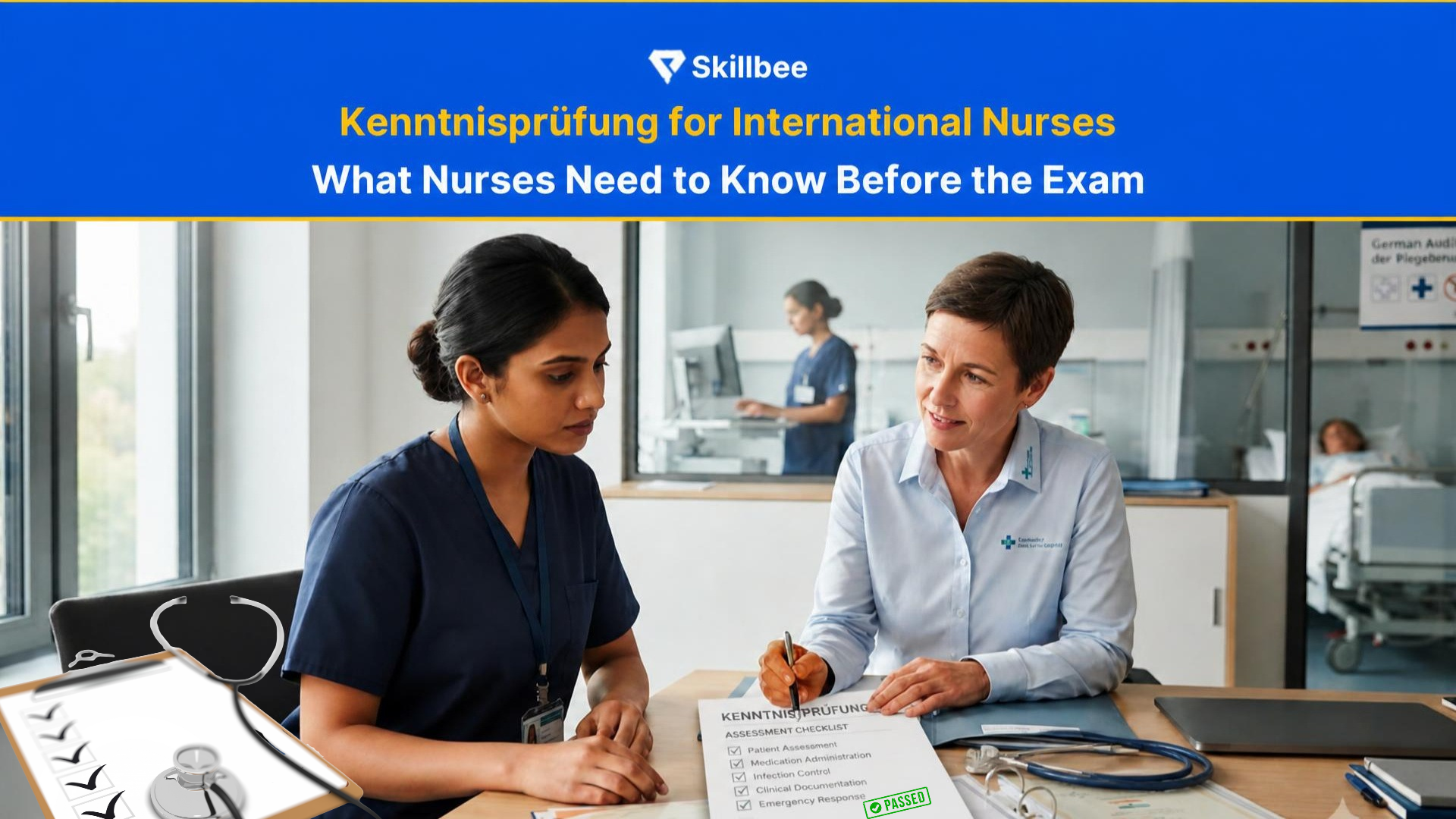
The Kenntnisprüfung is a professional examination for internationally trained nurses who need to show that their nursing knowledge and skills meet the standards required in Germany. It can form part of the nursing recognition process in Germany when the competent German authority identifies significant differences between a foreign nursing qualification and the corresponding German qualification.
As part of the nursing recognition process in Germany, nurses may receive a Defizitbescheid outlining the areas in which their qualification differs from the German standard. Depending on the individual recognition route, they may address these differences through a Kenntnisprüfung or an adaptation programme / Anpassungslehrgang. Whether you are preparing independently or looking for a structured roadmap, this Kenntnisprüfung guide is designed to help you navigate the process.
The examination is primarily relevant to nurses who completed their training outside Germany, including Indian nurses applying for professional recognition. It is important to understand that the Kenntnisprüfung is not a German-language examination. It focuses on professional competence, including nursing knowledge, clinical decision-making, patient safety, communication and the ability to provide care in line with German nursing standards.
This comprehensive Kenntnisprüfung guide covers the key aspects of the examination, including eligibility requirements, syllabus, oral and practical examination format, preparation strategies, common mistakes and practical tips to help candidates approach the exam with greater confidence. Keep this Kenntnisprüfung guide handy as a reference to ensure you cover all necessary competencies before your exam date.
What Is the Kenntnisprüfung in Germany?

As detailed in this Kenntnisprüfung guide, the exam is a professional examination for internationally trained nurses whose qualifications are not considered fully equivalent to the German nursing qualification. It is one of the possible compensatory measures in the nursing recognition process in Germany. The purpose of the exam, as highlighted in any good Kenntnisprüfung guide, is to determine whether a candidate has the professional knowledge and practical skills required to work as a qualified nurse in Germany.
A Kenntnisprüfung may be required after the competent German authority assesses a foreign nursing qualification and finds substantial differences compared with the German qualification. These differences are outlined in the Defizitbescheid. Depending on the individual case and the requirements of the relevant German state, the nurse may be able to choose between a Kenntnisprüfung and an adaptation programme / Anpassungslehrgang to address the identified gaps.
The exam is not simply a test of theoretical nursing knowledge or German language ability. It focuses on how candidates apply their professional knowledge in real nursing situations. This includes assessing patients, planning and providing appropriate nursing care, prioritising patient needs, communicating with patients and healthcare professionals, documenting care and evaluating the results of nursing interventions.
According to §45 of the Pflegeberufe-Ausbildungs- und -Prüfungsverordnung (PflAPrV), the Kenntnisprüfung consists of an oral examination and a practical examination. Candidates must pass both parts of the examination.
Detailed Kenntnisprüfung Exam Breakdown

Following the structure outlined in this Kenntnisprüfung guide, the examination for internationally trained nurses consists of two mandatory parts: an oral examination and a practical examination. Candidates must pass both parts to complete the exam. The examination covers Competency Areas I to V of the German nursing qualification framework.
1. Oral Examination
The Kenntnisprüfung oral examination is based on a complex patient case. Candidates are expected to analyse the situation, explain their approach, and demonstrate that they can apply their nursing knowledge to make appropriate clinical decisions.
- Duration: 45 to 60 minutes
- Format: Case-based oral examination
- Competency areas: At least three of the five competency areas must be covered
- Examiners: Two professional examiners
- Case requirements: The case must relate to a different care setting from the practical examination and, for candidates applying under §1 PflBG, involve a different age group.
During the Kenntnisprüfung oral examination, questions may cover how the candidate would assess the patient, identify nursing needs, prioritise care, plan appropriate interventions, communicate with the patient and healthcare team, and explain the reasoning behind their decisions.
2. Practical Examination
The practical examination focuses on the candidate’s ability to apply nursing knowledge in actual patient-care situations.
- Number of situations: At least 2 and up to 4
- Maximum duration: Up to 120 minutes for each nursing situation
- Setting: A practical care area specified by the competent authority
- Assessment: Nursing performance, the nursing process, nursing diagnostics and professional communication
- Examiners: Two professional examiners
During the examination, candidates need to show that they can independently plan, organise, carry out, manage and evaluate nursing care. Their communication with patients and relatives
Kenntnisprüfung Syllabus: What Do You Need to Study?

The syllabus discussed in this Kenntnisprüfung guide is built around the professional competencies expected of nurses working in Germany. It does not follow a simple checklist of diseases, treatments or nursing procedures. Instead, the examination looks at how well candidates can use their nursing knowledge in different patient-care situations.
The syllabus broadly covers five competency areas, including clinical care, communication, teamwork, professional responsibilities and evidence-based nursing practice.
- Nursing Processes and Nursing Diagnostics: One of the main areas highlighted in this Kenntnisprüfung guide. Nurses should be able to assess a patient’s condition, identify nursing needs, set appropriate goals, plan and carry out interventions, and evaluate results. Preparation should also cover prevention, rehabilitation, acute and chronic care, palliative care and patient safety.
- Communication and Counselling: Candidates should be prepared to communicate appropriately with patients, relatives and healthcare professionals, providing information, educating and counselling patients, explaining procedures, and addressing concerns.
- Interprofessional Cooperation: Candidates should understand how to collaborate with doctors, nurses and other healthcare professionals while maintaining their own professional responsibilities through proper handover, care coordination, and teamwork.
- Legal, Ethical and Professional Responsibilities: Important areas include patient rights, confidentiality, informed consent, documentation, professional duties, ethical decision-making, and basic nursing regulations relevant to professional practice in Germany.
- Evidence-Based Nursing and Professional Development: This section of the Kenntnisprüfung guide emphasizes connecting nursing practice with scientific knowledge, using evidence when making nursing decisions, and reflecting on professional practice.
How to Prepare for the Kenntnisprüfung

Preparing for the exam requires more than just revising nursing theory. As emphasized throughout this Kenntnisprüfung guide, you need to show that you can apply your knowledge to patient situations, explain your clinical decisions and master professional German language for nurses.
- Start With Your Defizitbescheid: Begin by reviewing your Defizitbescheid and any instructions provided by the competent authority. Make sure you understand your recognition route and check whether there are specific requirements or arrangements for your examination.
- Strengthen Your Nursing Process: Use the nursing process as the foundation of your preparation. When working through a patient case, practise moving from assessment and nursing problems to goals, interventions and evaluation. Do not just memorise procedures. Practise explaining why a particular intervention would be appropriate for the patient.
- Practise Case-Based Questions: Work through realistic patient scenarios from different areas of nursing care. For each case, practise identifying the most urgent needs, recognising potential risks, planning appropriate interventions and deciding when other healthcare professionals should be involved.
- Prepare for the Practical Examination: Practical preparation should go beyond individual nursing procedures. Revise hygiene, patient safety, documentation, communication and handovers, and practise performing procedures in a structured way. Supervised practical training can be particularly useful because it allows you to receive feedback on both your technique and your overall approach to patient care.
- Build Your Professional German: Developing fluency in professional German language for nurses is important. Focus on clinical terminology, patient interviews, handovers, and discussing clinical reasoning in German.
- Take Mock Examinations: Mock examinations can help you understand what to expect on the day of the exam. Practise both oral case discussions and practical situations under time limits. Use the feedback to identify gaps in your knowledge, communication, or practical skills and work on them before the actual examination.
Common Mistakes to Avoid in the Kenntnisprüfung

Even candidates with strong nursing knowledge can struggle if they are unfamiliar with the assessment criteria. Reviewing this section of the Kenntnisprüfung guide will help you steer clear of critical errors:
Focusing Only on Memorisation: Learning diseases, medications and nursing procedures by heart is useful, but it is only part of the preparation. During the exam, you may need to apply that knowledge to a particular patient situation and explain why you would take a specific course of action.
Preparing Only for the Practical Exam: It is easy to spend most of your preparation time practising nursing procedures and overlook the oral examination. Make sure you also practise discussing patient cases, explaining nursing decisions and answering questions related to communication, ethics and professional responsibilities.
Neglecting Professional German: Knowing the nursing theory is not enough if you cannot communicate it clearly in German. Spend time learning German nursing terminology and practise situations such as speaking with patients, giving handovers and explaining your clinical decisions.
Forgetting Documentation and Evaluation: Nursing care does not end after an intervention has been performed. Candidates should remember the complete nursing process, including assessment, planning, implementation, documentation and evaluation. Be prepared to explain how you would determine whether the care provided was effective.
Not Practising Patient Communication: Technical skills are only one part of nursing practice. Practise introducing yourself to patients, explaining what you are going to do, obtaining their cooperation, answering questions and communicating respectfully with patients and relatives.
Relying on a Generic Preparation Plan: Examination arrangements may differ depending on the competent authority and federal state. Information shared by other candidates may not apply to your individual case. Always use the instructions provided by the authority handling your recognition process as the basis for your preparation.
Kenntnisprüfung Pass Tips: How to Prepare Effectively

To wrap up this Kenntnisprüfung guide, here are top-tier tips to ensure success in the nursing recognition process in Germany enforces:
1. Think Like a Nurse, Not Just an Exam Candidate: When you receive a patient case, do not immediately jump to a procedure or treatment. Start by assessing the patient, identifying immediate risks, and deciding what needs attention first. From there, think about appropriate nursing interventions and how you would evaluate the results.
2. Explain the Reason Behind Your Decisions: Knowing what to do is important, but you should also be able to explain why you would do it. When answering questions, consider the patient’s condition, possible risks, expected outcomes and the reason for choosing a particular intervention.
3. Practise With Different Patient Situations: Do not prepare around a handful of familiar cases. Work through different situations involving acute and chronic conditions, older patients, postoperative care, emergencies, rehabilitation and palliative care. The more varied your practice, the easier it becomes to apply your knowledge to an unfamiliar case.
4. Strengthen Your Professional German: Make speaking about nursing part of your daily preparation. Practise conducting patient interviews, explaining procedures, giving professional handovers and discussing your clinical decisions in German. You should be able to communicate your reasoning, not just recall German medical terms.
5. Follow the Complete Nursing Process: Use a consistent structure when working through patient cases:
Assessment → Nursing problems → Goals → Interventions → Evaluation
Following this sequence can help you organise your thoughts and make your answers easier to follow during the examination.
6. Practise Under Examination Conditions: Try completing mock oral cases and practical situations within the relevant time limits. Ask an instructor or experienced nurse to observe you and give specific feedback. This can help identify gaps in your knowledge as well as problems with communication, organisation or practical technique.
7. Include Communication, Law and Ethics in Your Preparation: Do not treat these topics as secondary to clinical knowledge. Revise areas such as patient rights, confidentiality, consent, professional responsibilities and interprofessional communication alongside your clinical preparation. These are part of professional nursing practice and can become relevant when discussing patient cases.
Conclusion
The Kenntnisprüfung is a critical step for internationally trained nurses navigating the nursing recognition process in Germany mandates. Whether your path involves clearing the exam or completing an adaptation programme / Anpassungslehrgang, thorough preparation is key.
A structured preparation plan can make the process easier to manage. From understanding your Defizitbescheid and studying the five competency areas to practising case scenarios, practical skills and professional German, every stage of preparation matters.
For nurses planning their career in Germany, Skillbee provides support throughout the international nursing journey, including German language training, recognition guidance, documentation support and assistance with the German recruitment process. With the right preparation and professional support, internationally trained nurses can approach the recognition process with greater clarity and confidence.
 +91 73 6009 6009 (India)
 contact@skillbee.com
Leave a Reply