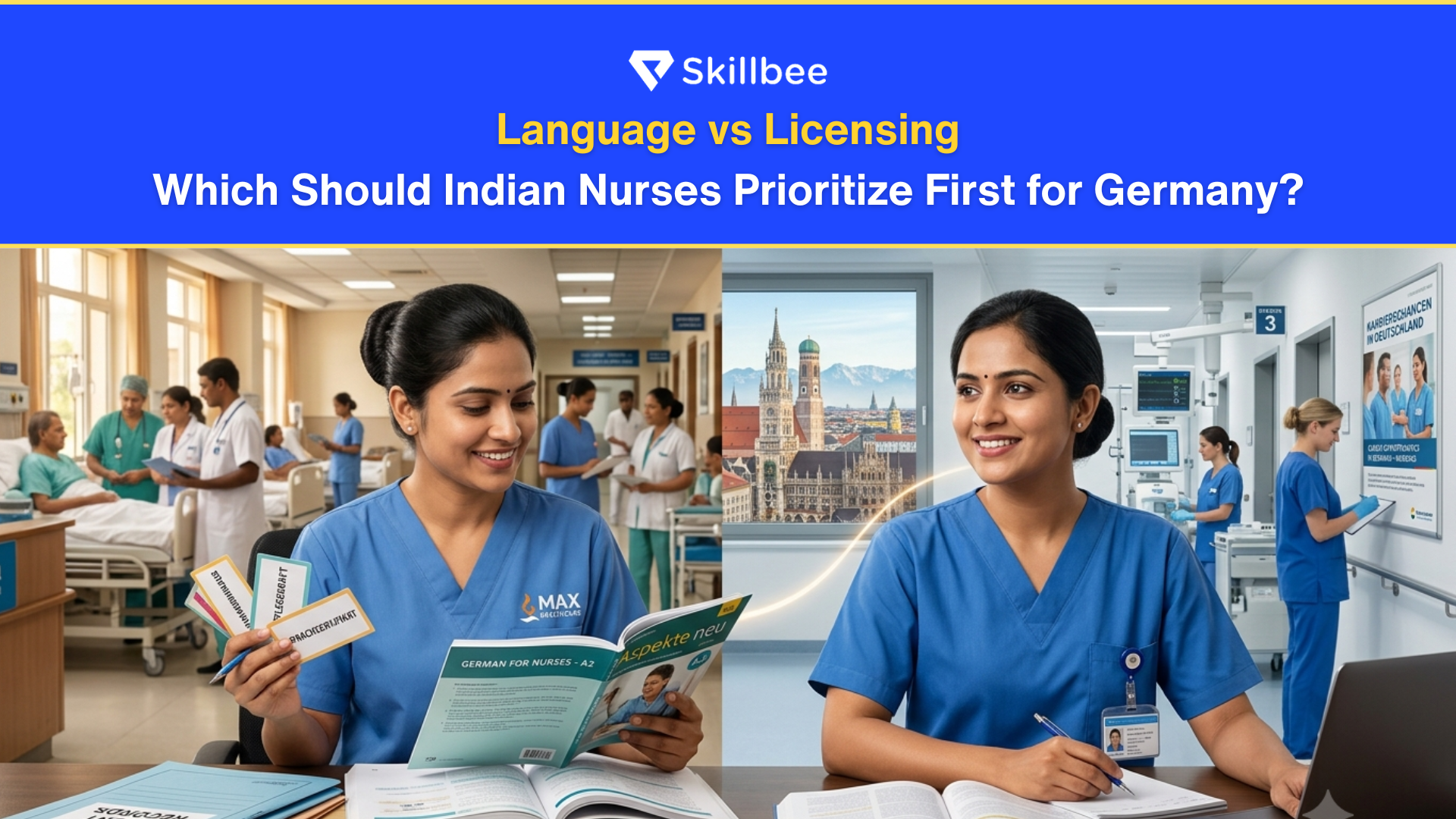
Germany has become one of the most attractive destinations for Indian nurses seeking international career opportunities. With a growing shortage of healthcare professionals, the country actively recruits skilled and qualified nurses from abroad.
However, before Indian nurses can work as registered nurses in Germany, they must meet two important requirements: proficiency in the German language and professional recognition through the nursing license recognition process in Germany. This often creates confusion about which step should be completed first, making it important to understand the realities of language vs. licensing for Indian nurses in Germany.
This article explains language vs licensing for Indian Nurses in Germany, why language should come first, and how nurses can effectively balance both language learning and licensing requirements for a successful nursing career in Germany.
Germany’s Growing Demand for Skilled Nurses

Many European countries, including Germany, are struggling with a shortage of workforce in various sectors. Germany is facing an acute deficit of nursing professionals in the healthcare sector. An ageing population, increasing life expectancy, and growing demands have created this vital need for qualified personnel across hospitals, rehabilitation centers, clinics, and elder care facilities.
Healthcare providers throughout Germany are struggling to fill nursing positions, prompting employers to actively recruit talent from non-EU countries. For those navigating language vs licensing for Indian Nurses in Germany, understanding how employers view foreign credentials is crucial. Fulfilling the necessary German language training for nurses is often the first hurdle candidates must clear when applying for positions from abroad.
Indian nurses are particularly valued because of their strong educational background, clinical training, and adaptability. Many German employers recognize the high standards of training in India and appreciate the dedication of these professionals.
This demand has opened excellent opportunities for international careers, competitive salaries, and long-term professional growth. However, before starting, candidates must successfully balance language vs licensing for Indian Nurses in Germany to satisfy legal standards.
Why Language Takes Priority: Language vs Licensing for Indian Nurses in Germany

An aspiring nurse should understand the migration process thoroughly. Foreign-trained nurses must fulfill two essential requirements before they can work as registered nurses in Germany: demonstrating strict German language requirements and completing the nursing license recognition workflow in Germany. When evaluating B1 vs B2 German for nurses, candidates navigate Language vs Licensing for Indian Nurses in Germany to ensure their qualifications meet all legal standards.
German Language Proficiency
Nurses must demonstrate adequate German language skills to communicate effectively in healthcare settings while managing all necessary nursing documents required for Germany.
In most German states:
- Meeting the official German language requirements at a B1-level is required to begin the nursing license recognition process in Germany.
- Understanding B1 vs B2 German for nurses helps clarify why B2-level proficiency is generally required for regular employment.
- Strong communication skills, reinforced while resolving language vs licensing for Indian Nurses in Germany, are necessary for patient care, workplace integration, and professional development.
Professional Recognition (Anerkennung)
The second core requirement in language vs licensing for Indian Nurses in Germany involves gathering all nursing documents required for Germany to obtain professional recognition through the process known as Anerkennung. This assessment determines whether your education, training, and professional qualifications are equivalent to German standards. Fulfilling official German language requirements alongside these checks is essential before you can work as a registered nurse in Germany.
The recognition process includes:
- Submission of education credentials using the exact nursing documents required for Germany.
- Verification of nursing qualifications tied to nursing license recognition in Germany.
- Assessment of work experience alongside German language requirements.
- Evaluation of training curriculum and review of B1 vs B2 German for nurse benchmarks.
- Completion of additional requirements if qualification gaps are identified during the language vs licensing for Indian Nurses in Germany assessment.
Both requirements are essential, but understanding their relationship is important when planning a successful migration journey.
Why Language Should Come First

Many nurses focus primarily on licensing because they believe professional qualifications are the most important requirement. While qualifications are certainly important, language proficiency is the foundation upon which the entire process depends.
Language Is Essential for Safe Patient Care
When discussing language vs licensing for Indian Nurses in Germany, it’s important to understand why German language proficiency is considered a top priority. Nurses interact with patients. When discussing language vs licensing for Indian Nurses in Germany, it’s important to understand why meeting strict German language requirements is considered a top priority.
Nurses interact with patients more than any other healthcare professionals, making effective communication essential. Strong language skills, especially when navigating B1 vs B2 German for nurses, are required not only to meet regulatory standards but also to ensure safe patient care, build trust, and collaborate effectively while managing all nursing documents required for Germany.
Every day, nurses are expected to:
- Assess patient symptoms while utilizing knowledge of nursing license recognition in Germany.
- Explain treatments and procedures after fulfilling core German language requirements.
- Provide medication instructions aligned with B1 vs B2 German for nursing standards.
- Respond to emergencies requiring fluency evaluated during the language vs licensing for Indian Nurses in Germany assessment.
- Communicate with family members while submitting nursing documents required for Germany.
- Document patient conditions accurately to satisfy nursing license recognition guidelines in Germany.
In Germany, all of these responsibilities must be carried out in German. Without strong language skills, misunderstandings can occur, potentially affecting patient safety and treatment outcomes. This is one of the primary reasons German healthcare employers place significant importance on language proficiency.
The language vs licensing for Indian Nurses in Germany discussion often highlights that while clinical knowledge is essential, it is not enough on its own. Balancing German language requirements and evaluating B1 vs B2 German for nurses alongside knowledge of license recognition ensures that your nursing documents required for Germany translate into real-world success. A nurse may possess excellent medical skills, but without the ability to communicate clearly with patients, doctors, and colleagues in German, delivering safe, high-quality care becomes significantly more challenging. This is why language proficiency is considered a fundamental requirement alongside professional licensing for nurses planning to build a successful career in Germany.
Language Supports Workplace Integration
The importance of language vs licensing for Indian Nurses in Germany extends far beyond patient care, tying directly into the nursing documents required for Germany and overall career mobility. Working in Germany involves much more than treating patients, requiring candidates to meet strict German language requirements while pursuing nursing license recognition in Germany.
Nurses must collaborate with doctors, fellow nurses, healthcare assistants, therapists, administrative staff, and patients’ families, all while mastering milestones outlined in B1 vs B2 German for nurses.
German hospitals operate in fast-paced environments where teamwork is critical. Nurses who can communicate confidently in German, a core focus when evaluating Language vs Licensing for Indian Nurses in Germany, are more likely to integrate successfully into the workplace, build strong professional relationships, and adapt quickly to their new environment.
Strong language skills, backed by the proper nursing documents required for Germany, also reduce workplace stress, improve collaboration across multidisciplinary teams, and increase confidence during daily interactions. This is one of the key reasons why satisfying German language requirements and achieving nursing license recognition in Germany are prioritised alongside professional licensing for Indian nurses planning to build a sustainable career through structured German language training for nurses and B1 vs B2 German pathways.
Language Is Required for Recognition
Many nurses who are learning or are going to learn the German language for a better career in Germany are surprised to learn that language proficiency is closely linked to the Anerkennung process. In most cases, nurses need to pass the mandatory German language requirement at a B1 level before their recognition application can be processed effectively.
Without meeting this baseline requirement, the licensing process may be delayed significantly. This means that even a skilled nurse with great experience cannot progress smoothly through the recognition process unless they have learned the German language.
Language Is Required for Recognition
Many nurses who are learning or are going to learn the German language for a better career in Germany are surprised to learn that language proficiency is closely linked to the Anerkennung process. When navigating language vs licensing for Indian Nurses in Germany, candidates must fulfill specific German language requirements before their application can be processed. In most cases, nurses need to pass the mandatory language exam at a B1 level—part of understanding B1 vs B2 German for nurses- before their recognition application can be processed alongside the nursing documents required for Germany.
Without meeting this baseline requirement, the licensing process may be delayed significantly. This means that even a skilled nurse with great experience cannot progress smoothly through nursing license recognition in Germany unless they have satisfied the official German language requirements, gathered all nursing documents required for Germany, and mastered the core milestones of B1 vs B2 German for nurses.
B2 German Is Necessary for Employment
While B1 German is usually sufficient to initiate recognition procedures, B2-level proficiency is While german language requirements are generally required for professional employment; mastering B1 vs B2 German for nurses is critical for career advancement. Within this framework, achieving the B2 milestone allows candidates to submit the correct nursing documents required for Germany and accelerate their nursing license recognition journey.
At the B2 level, nurses can:
- Communicate independently with patients while fulfilling strict German language requirements.
- Understand medical terminology as part of mastering B1 vs B2 German for nurses.
- Participate in clinical discussions crucial for nursing license recognition in Germany.
- Follow healthcare protocols outlined in the nursing documents required for Germany.
- Complete nursing documentation accurately while navigating the recognition process for both language proficiency and license through dedicated German language training for nurses.
Employers prefer candidates who already possess strong language skills because they can integrate into the workplace more quickly and provide safe patient care from the beginning.
Understanding the Anerkennung Process

Although the process often emphasises the importance of learning German first, professional recognition remains an equally essential step. The Anerkennung process ensures that international nursing qualifications meet official German language requirements and nursing license recognition standards in Germany. Understanding how the process works, while coordinating the nursing documents required for Germany and analyzing B1 vs B2 German for nurses, can help candidates prepare effectively and avoid unnecessary delays.
Step 1: Document Collection
The process begins with gathering all required documentation. Common documents include:
- Nursing degree certificates.
- Academic transcripts.
- Nursing registration certificates.
- Experience certificates.
- Course curriculum and syllabus.
- Identity and passport documents.
Collecting these documents early can significantly speed up the process of the language and license journey and help prevent delays during the recognition process.
Step 2: Qualification Assessment
German authorities evaluate whether the applicant’s education and training are comparable to German nursing qualifications. This assessment examines:
- Duration of study.
- Clinical training.
- Course content.
- Professional experience.
The goal is to determine whether the nurse possesses the competencies expected from a German-trained nurse.
Step 3: Recognition Decision
Following the assessment, the authorities issue a decision. There are typically two possible outcomes:
Partial Recognition: If differences are identified between the applicant’s training and German standards, additional measures will be required. This is a common outcome for many international applicants.
Full Recognition: If qualifications are considered equivalent, the nurse may proceed toward full professional recognition.
Step 4: Adaptation Program or Knowledge Examination
When qualification gaps exist, nurses are usually required to complete one of the following:
- Adaptation Program (Anpassungslehrgang): This practical training program takes place in a German healthcare facility. The adaptation program helps nurses familiarize themselves with German healthcare practices, documentation procedures, and workplace standards.
- Knowledge Examination (Kenntnisprüfung): This examination assesses nursing knowledge and practical competencies. Candidates must demonstrate that they possess the required skills and understanding expected of German nurses.
Both options are conducted in German, making language proficiency essential for success.
Step 5: Final Recognition
After successfully meeting all requirements, nurses receive official recognition and can work as registered nurses in Germany. This recognition provides access to higher salaries, better career opportunities, full professional rights, long-term employment security, and pathways toward permanent residency.
Ultimately, Language vs Licensing for Indian Nurses in Germany is not a choice between one requirement and the other. While learning German should come first, completing the licensing process is what enables nurses to build a successful and rewarding career in Germany’s healthcare system.
Why Licensing Alone Is Not Enough

A common misconception in Language vs Licensing for Indian Nurses in Germany is that obtaining professional recognition automatically guarantees employment. In reality, mastering German language requirements and gathering all nursing documents required for Germany is only part of the journey. Even after receiving official license recognition in Germany, nurses must be able to work effectively within German healthcare environments while demonstrating proficiency aligned with B1 vs B2 German for nurses.
German employers evaluate candidates on several factors, including:
- Communication skills evaluated under strict German language requirements.
- Cultural adaptability required during the Language vs Licensing for Indian Nurses in Germany transition.
- Professional competence verified through nursing license recognition in Germany.
- Teamwork abilities supported by mastering B1 vs B2 German for nurses.
- Patient interaction capabilities guided by the proper submission of nursing documents required for Germany.
Without adequate German language skills, even fully recognised nurses may struggle during job interviews, workplace orientation, clinical training, and everyday professional responsibilities. This is why satisfying German language requirements should be prioritised alongside nursing license recognition in Germany. Strong communication skills, honed through mastery of B1 vs B2 German for nurses and supported by accurate nursing documents required for Germany, not only improve employability but also help nurses integrate into the workplace, deliver safe patient care, and build a successful long-term career while navigating language vs licensing for Indian Nurses in Germany.
Fully recognised nurses may struggle during job interviews, workplace orientation, clinical training, and everyday professional responsibilities. This is why language proficiency should be prioritised before or alongside the licensing process. Strong German communication skills not only improve employability but also help nurses integrate into the workplace, deliver safe patient care, and build a successful long-term career in Germany.
How Indian Nurses Can Balance Language and Licensing

The good news is that the nurses do not need to complete one requirement before starting the other. A strategic approach allows candidates to work on other skills simultaneously while prioritizing language development.
Begin German Language Training Early
The sooner the nurses begin learning the German language, the smoother their whole process will be. To comfortably clear the German language requirement, the nursing candidate typically needs to progress through all the levels of the German language from A1 to B2 level. Early preparation provides sufficient time to build confidence and also develop both general and medical vocabulary.
Collect Documents During Language Training
While attending the German language classes, nurses can begin gathering educational and professional documents. These documents include:
- Degree Certificate
- Mark Sheets
- Registration Certificates
- Employment letters
- Curriculum details
Handling documentation alongside language study saves valuable time.
Prepare Translations and Verification
Many documents require certified German translations and verification. Completing these administrative tasks while studying German helps streamline the overall process.
Apply for Recognition at B1 Level
Once B1 proficiency is achieved, nurses can usually submit their recognition application. At this stage, German authorities can begin evaluating qualifications while candidates continue progressing toward B2.
Continue Toward B2 Certification
After submitting the recognition application, nurses should focus on achieving B2-level proficiency. This stage is critical because B2 is generally required for employment contracts, professional practice, workplace communication, and patient care responsibilities. Achieving B2 before employment significantly improves career prospects
Common Mistakes Indian Nurses Should Avoid

Understanding the common challenges in language vs licensing for Indian Nurses in Germany can help aspiring nurses avoid costly mistakes and complete the migration process more efficiently. Here are some of the most common pitfalls:
Delaying Language Learning
Many nursing candidates focus primarily on collecting and verifying documents, postponing German language learning until later. However, this can significantly extend the overall timeline. Since successful professional integration in Germany depends on effective day-to-day communication, starting German language training for nurses as early as possible is one of the smartest decisions an aspiring nurse can make.
Underestimating the Importance of B2
Some candidates believe that reaching B1 is enough to work in Germany. While B1 is often sufficient to begin the recognition (Anerkennung) process, B2-level proficiency in German is generally required for employment as a registered nurse. Achieving B2 also improves confidence during interviews, workplace training, and patient interactions.
Incomplete Documentation
Missing certificates, inaccurate records, or incomplete applications can delay the recognition process. Preparing all required documents carefully from the beginning helps minimise complications and speeds up the assessment of nursing qualifications.
Ignoring Medical German Vocabulary
Learning conversational German is essential, but it is not enough for clinical practice. Nurses should also develop healthcare-specific language skills, including medical terminology, patient communication, and documentation. These skills are vital for delivering safe, high-quality care in German healthcare settings.
Navigating the Process Without Guidance
The recognition and migration journey can be complex, especially for first-time applicants. Seeking professional guidance can help candidates understand the requirements, avoid common mistakes, prepare the required documentation, and navigate the Language vs Licensing for Indian Nurses in Germany process more efficiently and confidently.
How Skillbee Supports Indian Nurses
Successfully navigating Language vs Licensing for Indian Nurses in Germany involves much more than meeting the basic eligibility requirements. The journey includes language training, document preparation, professional recognition, visa processing, and securing employment, each of which requires careful planning and execution.
At Skillbee, we support aspiring Indian nurses at every stage of their international career journey. Our team provides comprehensive assistance with:
- Career guidance and counselling
- Specialized support for German language training for nurses
- Documentation preparation
- Professional recognition (Anerkennung) assistance
- Employer connections and job opportunities
- Interview preparation
- Visa and relocation guidance
By providing end-to-end support, we help Indian nurses navigate the Language vs Licensing for Indian Nurses in Germany process with confidence. From learning German and completing the recognition process to securing a nursing job and relocating to Germany, Skillbee simplifies every step so candidates can focus on building a successful and rewarding healthcare career.
Conclusion
For Indian nurses planning a career in Germany, both German language proficiency and professional recognition are essential requirements. However, language should always be the first priority because it forms the foundation of every stage of the journey.
From initiating the Anerkennung process and completing adaptation programs to communicating with patients and securing employment, strong German language skills are critical for success. While licensing validates professional qualifications, language enables nurses to apply those qualifications effectively within the German healthcare system.
The most effective strategy is to begin structured German language training for nurses as early as possible, progress steadily from A1 to B2, and prepare licensing documents simultaneously. This balanced approach minimizes delays and creates a smoother pathway toward a successful nursing career in Germany.
If you are an Indian nurse aspiring to work in Germany, Skillbee is here to support you at every step. With the right preparation, guidance, and commitment, your dream of building a rewarding international nursing career can become a reality.
 +91 73 6009 6009 (India)
 contact@skillbee.com
Leave a Reply