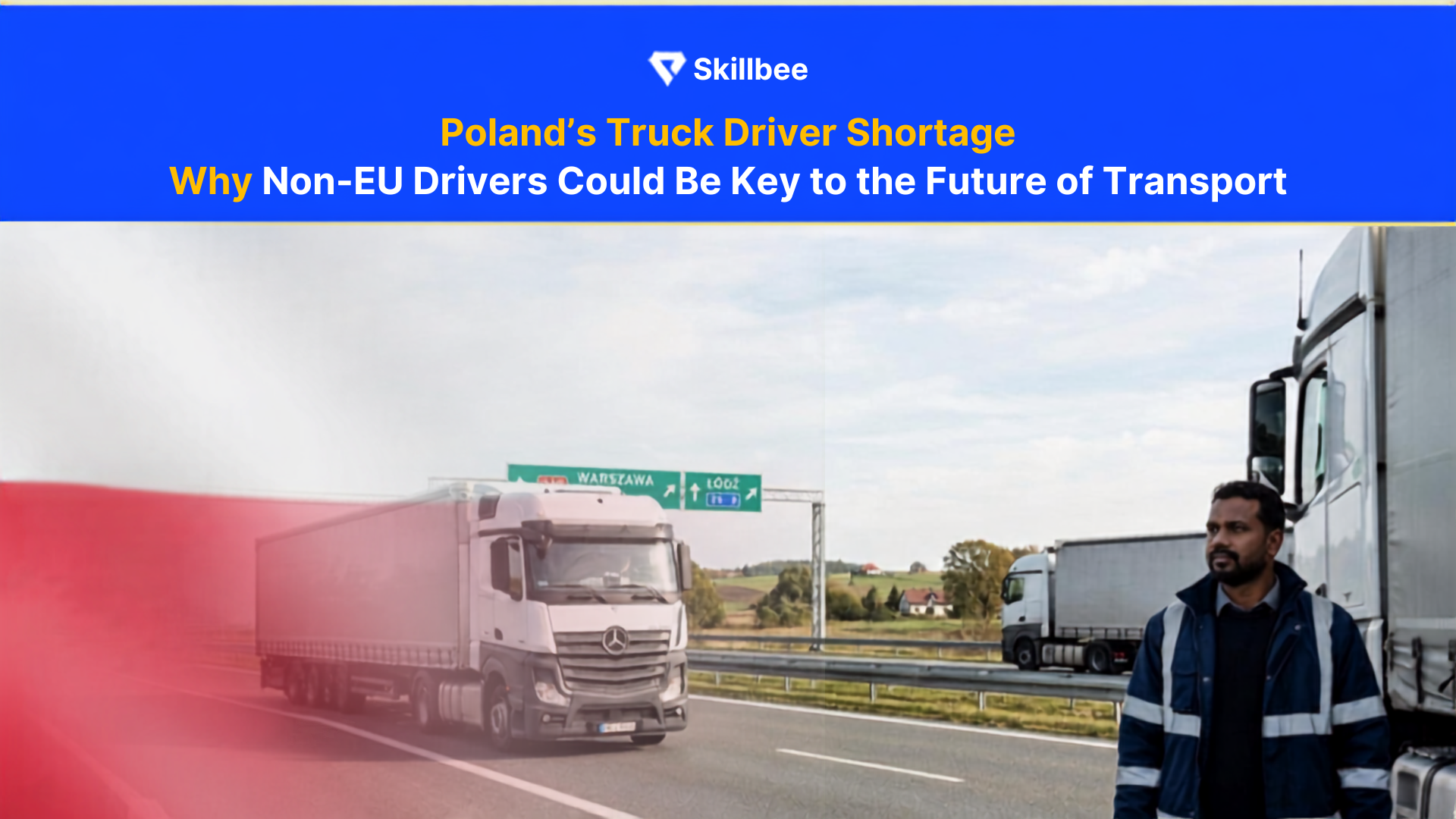
Poland has become one of Europe’s leading road freight markets, connecting major economies through extensive transport routes. However, keeping this network moving is becoming increasingly challenging as the country faces a growing Polish truck driver shortage, driven by a lack of qualified drivers and an ageing workforce.
With demand for road freight continuing to rise, Polish transport companies are finding it harder to fill vacancies and maintain fleet capacity. This growing Polish transport sector labor gap is making Non-EU truck drivers in Poland increasingly important to the industry.
However, international truck driver recruitment in Europe can involve lengthy employment, immigration and documentation procedures. The Transport and Logistics Poland (TLP) association has called for more efficient processes to help businesses address these labour shortages.
For Polish carriers, recruiting Indian trailer drivers for Europe could provide access to experienced professionals, provided candidates meet the required licensing, professional, and legal requirements.
Poland’s Growing Truck Driver Shortage

Poland’s transport industry has grown rapidly over the years, but the number of professional drivers has not kept pace with demand. The Poland truck driver shortage is becoming a growing concern for transport companies, which are increasingly struggling to find qualified drivers to keep their fleets operating at full capacity.
The problem is not simply about filling a few vacant positions. Poland, like many European countries, is dealing with an ageing driver workforce. Many experienced drivers are approaching retirement, while fewer young people are entering the profession. This is creating a growing Polish transport sector labour gap, widening the gap between the number of drivers available and the number needed by the industry.
At the same time, road freight remains essential to Poland’s economy. Polish carriers operate extensively across Europe, handling everything from domestic deliveries to long-distance international routes. As freight volumes and cross-border transport activity grow, carriers need a steady supply of professional drivers.
This combination of rising demand, an ageing workforce and limited new entrants is turning the Poland truck driver shortage into a structural challenge. Simply increasing recruitment within Poland may not be enough to meet the industry’s long-term needs.
For transport companies, the shortage can have a direct operational impact. Trucks may remain idle when there are not enough qualified drivers, while companies can also face difficulties taking on new contracts or expanding their fleets. This is making access to qualified truck drivers in Poland increasingly important for the continued growth of the transport sector.
This is why Polish carriers are increasingly looking beyond the domestic labour market. Non-EU truck drivers in Poland are becoming an important part of the workforce, helping companies address driver shortages and maintain fleet capacity.
For carriers looking to fill persistent vacancies, recruiting Indian trailer drivers for Europe can provide access to an additional pool of experienced professionals. More broadly, international truck driver recruitment in Europe is becoming an increasingly relevant strategy as transport companies across the continent face similar workforce challenges.
Why Non-EU Drivers Are Becoming Essential

For Polish transport companies, hiring non-EU truck drivers in Poland is no longer just an alternative recruitment strategy. It is becoming an increasingly important way to address the growing Poland truck driver shortage and narrow the Polish transport sector labor gap.
Non-EU truck drivers in Poland are already a significant part of Poland’s international road transport workforce. Many Polish carriers have turned to drivers from third countries because they bring the experience needed for long-distance and cross-border operations. Their contribution helps companies keep vehicles moving and meet the demands of customers across Europe.
There is also a practical reason behind this shift. When the domestic pool of qualified drivers is limited, companies need to look further afield, using broader international truck driver recruitment in Europe. Countries outside the EU, including recruiting Indian trailer drivers for Europe and candidates from several other countries in Asia, provide access to large pools of professional drivers with experience in heavy vehicles and long-haul transport.
However, recruiting internationally is not as simple as finding an experienced driver and offering them a job. Drivers still need to meet the relevant professional, licensing, immigration, and employment requirements before they can legally work in Poland and operate within the EU.
For carriers, therefore, the challenge is twofold: finding suitable drivers and getting them through the necessary procedures efficiently. When these processes take too long, a company may have a qualified candidate ready to join but still be unable to put that driver behind the wheel.
This is why the role of non-EU drivers is closely connected to the wider discussion around Poland’s foreign-worker employment procedures. If international recruitment is going to help solve the Poland truck driver shortage, companies need a process that is not only accessible but also predictable and efficient.
What Is TLP Calling For?

The growing dependence on foreign drivers has also brought attention to the procedures Polish transport companies must follow when employing workers from outside the EU.
The Transport and Logistics Poland (TLP) association has been calling for changes that would make the employment of foreign workers faster and more efficient. The concern is straightforward: when carriers are already struggling with the Poland truck driver shortage, lengthy administrative procedures can make the Polish transport sector labor gap even harder to manage.
For a transport company, recruitment does not end when a suitable driver is selected. Candidates, such as non-EU truck drivers in Poland, may still need to complete work authorisation, residence, and other formalities before they can legally begin employment. Whether a company is relying on standard procedures or recruiting Indian trailer drivers for Europe, if these steps take too long, the carrier can be left waiting for a driver it has already recruited.
TLP’s position focuses on making these processes more responsive to the needs of businesses, particularly sectors like road transport where labor shortages are already affecting operations. Streamlining international truck driver recruitment in Europe is vital for maintaining steady supply chains.
The aim is not simply to make it easier to hire foreign workers. It is about creating a faster and more predictable pathway from recruitment to legal employment. This could help carriers respond more quickly when they have vacancies and reduce the time between selecting a driver and actually having that driver available for work.
For an industry operating across tight schedules and international routes, that predictability matters. Resolving the Poland truck driver shortage through efficient recruitment will ensure companies can better manage fleets, fulfill contracts, and secure future growth.
How Delays Affect Transport Companies

For a transport company, hiring a driver is only the first step. Before non-EU truck drivers in Poland can start working, several legal and administrative requirements may need to be completed. Work authorisation, residence formalities, and other documentation can all add time to the recruitment process.
The difficulty arises when these procedures take longer than expected. A carrier may have already interviewed a driver, verified their experience, and planned their employment, but still have to wait before that person can legally begin working. This added waiting time further complicates the broader Poland truck driver shortage and deepens the Polish transport sector labor gap.
For an industry that depends heavily on keeping trucks on the road, these delays can have a real operational impact. A vacant driver position can mean a truck is sitting unused, routes may need to be rearranged, and existing drivers may have to cover additional work. In some cases, companies may also have to turn down new transport contracts because they do not have enough drivers available.
The issue becomes even more important for carriers operating internationally. European road freight often involves tight schedules and long-distance routes, so companies need to know when their drivers will actually be available. Streamlining processes like recruiting Indian trailer drivers for Europe is crucial to ensuring a steady flow of qualified personnel.
This is why speed alone is not the only concern; predictability is equally important. Transport companies need an efficient international truck driver recruitment pipeline in Europe that allows them to plan their workforce with greater certainty.
If Poland wants to make better use of the international driver pool, reducing unnecessary delays in these procedures could help carriers bring qualified non-EU drivers into the workforce more efficiently.
Can International Recruitment Help Close the Driver Gap?

International recruitment can be an important part of Poland’s answer to the Poland truck driver shortage, but it is not a standalone solution. Polish carriers still need to attract and retain local drivers while also making the profession more appealing to younger workers to help narrow the Polish transport sector labor gap.
The advantage of relying on non-EU truck drivers in Poland is that it gives companies access to a much larger pool of experienced professionals. Instead of competing for the same limited group of drivers within the domestic market, carriers can look for qualified candidates through international truck driver recruitment in Europe, finding talent in countries where heavy-vehicle driving is already an established profession.
But hiring internationally requires more than simply finding someone with years of driving experience. Whether a company is recruiting Indian trailer drivers for Europe or sourcing candidates from other regions, drivers need to meet the relevant licensing, professional qualification, and employment requirements for working in Poland and across the EU. Their driving history, documents, skills, and ability to adapt to European regulations also need to be properly assessed.
This makes structured recruitment and compliance support particularly important. A reliable process should cover candidate screening, document verification, qualification requirements, and the necessary immigration and employment procedures.
When these steps are handled properly, international recruitment can give Polish carriers a more sustainable way to address driver shortages. It can help companies fill vacancies while maintaining the professional standards required for safe and compliant European road transport.
Ultimately, the goal is not to replace Poland’s existing driver workforce with foreign workers. It is to add qualified drivers to the available talent pool at a time when the industry needs more people behind the wheel.
Why India Could Be a Potential Talent Pool

India is home to a large pool of professional truck drivers, many of whom already have experience handling heavy vehicles and long-distance routes. For Polish carriers facing a shortage of qualified drivers, this makes India a potentially valuable source of international talent.
One advantage is the experience many Indian drivers gain through long-haul transport. Drivers who have worked across different regions and challenging road conditions may already be comfortable with extended journeys, vehicle handling, and the responsibilities that come with transporting cargo over long distances.
Gulf experience can also be valuable. Indian drivers who have worked in countries such as the UAE, Saudi Arabia, Oman or Qatar may already have experience working in international transport environments, following employer procedures and adapting to different road and safety requirements.
However, experience alone does not automatically qualify a driver to work in Poland or elsewhere in the EU. European licensing, professional qualifications, driver training, documentation and immigration requirements still need to be met. Drivers may also need to understand European driving-time rules, tachograph requirements and other regulations that apply to professional road transport.
This is where a structured recruitment process becomes important. Instead of simply connecting a driver with an overseas employer, international recruitment needs to consider the complete journey, from assessing the driver’s experience and qualifications to preparing the required documentation and supporting the relocation process.
For Polish carriers, India therefore represents more than a large labour market. With the right screening, training and compliance processes in place, it could provide access to experienced professional drivers who can contribute to Europe’s growing transport needs.
Conclusion
Poland’s truck driver shortage is becoming a long-term challenge for an industry that plays a critical role in keeping European trade moving. An ageing workforce, fewer young people entering the profession and continued demand for road freight mean that Polish carriers need to explore new ways to strengthen their driver workforce.
International recruitment can be an important part of that solution. Experienced non-EU drivers can help carriers fill vacancies and maintain fleet capacity when the domestic supply of qualified drivers is not enough. However, successful recruitment depends on more than simply finding drivers. Candidates need to meet the required professional, licensing, and legal requirements, while employers need a recruitment process that is reliable and well-structured.
This is where access to international talent can make a difference. Skillbee recruits experienced trailer drivers from India, the Middle East and South Africa for opportunities across Europe, helping connect transport companies with professional drivers beyond their domestic labour markets.
As Poland continues to address its driver shortage, a combination of local recruitment, international talent and more efficient employment procedures could help create a stronger and more sustainable workforce for the road transport sector.
 +91 73 6009 6009 (India)
 contact@skillbee.com
Leave a Reply