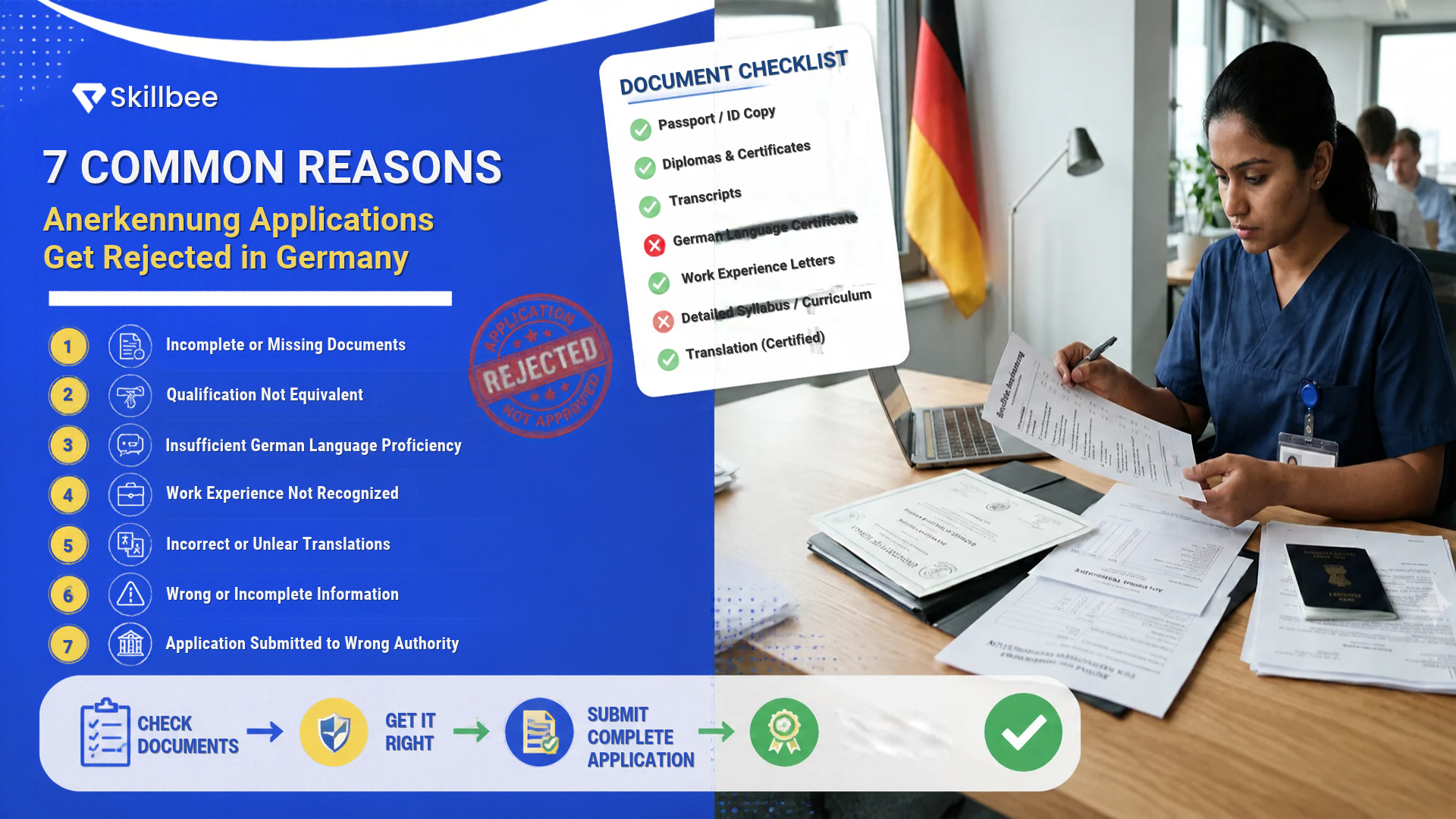
Anerkennung in Germany is the official recognition process for foreign nursing qualifications so that qualified nurses can easily work in the German healthcare system. For Indian nurses, this process involves assessing their nursing education and also training against the standards required for the German nursing profession. The competent recognition authority reviews qualifications, clinical training, professional experience, and other required documents before making a decision.
However, an Anerkennung application may face delays, requests for additional documents, partial recognition or, in some cases, rejection. Common issues include incomplete paperwork, incorrect translations, and differences between nursing education systems. Understanding these challenges can help applicants prepare more effectively by knowing the primary Anerkennung rejection reasons.
Whether you hold a GNM diploma or BSc Nursing degree, your qualification is not automatically rejected simply because you studied in India. Each application is assessed individually under the Anerkennung process for GNM / BSc Nursing candidates. By understanding the seven common reasons for Anerkennung application rejection, you can avoid preventable mistakes, prepare your documents carefully, and also take the right steps towards pursuing a successful German nursing recognition for Indian nurses.
Common Reasons for Anerkennung Applications Rejection
1. Incomplete or Missing Documents

One of the most common reasons for delays in the Anerkennung process is submitting an incomplete application. German recognition authorities require specific documents to assess nursing qualifications and determine whether the candidate’s education meets German standards. If important documents are missing, the authority may request additional information, which can extend processing times—a very common factor among Anerkennung rejection reasons.
Indian nurses applying for Anerkennung in Germany may need to submit their GNM diploma or BSc Nursing degree certificate, academic transcripts, nursing registration certificate, detailed records of clinical training, curriculum vitae, and relevant work experience certificates. A passport copy and other supporting documents may also be required, depending on the responsible authority.
How to avoid this mistake: Before submitting your application, check the official document checklist for the German state where the candidate intends to work. Ensure that all the required documents are complete, accurate, and prepared properly. Careful document preparation can help prevent unnecessary delays and make the Anerkennung process for GNM / BSc Nursing applicants much smoother.
2. Incorrect or Unauthorised German Translations

Submitting documents with incorrect translations or without the required certification can create severe problems during the Anerkennung process. German recognition authorities need to understand your nursing qualifications, academic records, and professional experience clearly. If your documents do not meet the authority’s translation requirements, you may be asked to provide corrected versions, leading to additional delays or rejections.
Indian nurses may need to translate documents such as nursing certificates, academic transcripts, registration records, and employment letters into the German language. Obtaining an accurate German translation for Anerkennung is essential. However, the exact requirements depend on the competent recognition authority. Some authorities may require translations prepared by sworn or authorised translators, while others may accept specific alternative arrangements.
How to avoid this mistake: Check the official requirements before arranging translations. Confirm whether your documents need certified copies, an official German translation for Anerkennung by an authorised translator, or any additional authentication. Do not assume that a notarised document or a translation from any general agency will automatically be accepted. Preparing your documents according to the authority’s instructions can help reduce avoidable delays and avoid typical Anerkennung rejection reasons.
3. Significant Differences Between Indian and German Nursing Education

One important reason an Anerkennung application may not lead to full recognition is the difference between the nursing education completed in India and the training standards required in Germany. During the assessment, the recognition authority compares your qualifications, theoretical knowledge, and practical clinical training with the German reference qualification for nursing professionals. Achieving German nursing recognition for Indian nurses depends heavily on how closely these standards align.
For Indian nurses, differences may relate to the subjects covered during training, the number of clinical practice hours, the structure of the curriculum, or specific areas of professional nursing practice. The authority evaluates the documents submitted to determine whether these differences can be identified and addressed.
Does a GNM or BSc Nursing qualification automatically get rejected?
No, neither a GNM diploma nor a BSc Nursing degree guarantees automatic recognition or automatic rejection. Under the Anerkennung process for GNM / BSc Nursing, each application is assessed individually, based on the applicant’s education and supporting evidence.
If substantial differences are identified, the authority may issue a Defizitbescheid (deficiency notice), explaining the gaps and the compensatory measures required. Depending on the decision, these may include an adaptation course (Anpassungslehrgang) or a knowledge examination (Kenntnisprüfung). Understanding these requirements can help you navigate the process effectively.
4. Applying to the Wrong Recognition Authority

Another common mistake during the Anerkennung process is applying to the wrong recognition authority. Germany has different competent authorities across its federal states, and the office responsible for assessing candidate nurse qualifications depends on where you intend to work and the applicable state requirements.
For candidates seeking German nursing recognition for Indian nurses, identifying the correct authority is an important first step. Each authority may have its own application forms, document requirements, and procedures. Submitting your application to an incorrect office may result in additional correspondence, redirection, or delays while you determine where the application should be processed.
How to avoid this mistake: Before starting your Anerkennung application, identify the German state where you plan to work and check which authority handles nursing qualification recognition there. You can use the official Anerkennung in Deutschland portal’s Recognition Finder to locate the relevant office and review its specific application requirements. Avoid relying solely on information from friends, social media, or applicants applying in another state, as their procedures may differ from yours.
Avoid relying solely on information from friends, social media or applicants applying in another state, as their procedures may differ from yours.
Choosing the correct recognition authority from the beginning can help you avoid unnecessary complications and move forward with your nursing career plans in Germany.
5. Insufficient Proof of Nursing Experience or Additional Training

Professional experience and additional training may be relevant when a German recognition authority assesses your nursing qualifications. However, simply mentioning your work experience in an application may not be enough. You may need to provide supporting documents that clearly establish your employment history, responsibilities, and relevant training.
For Indian nurses applying for Anerkennung in Germany, problems can arise when experience certificates contain incomplete information, employment dates are unclear, or documents do not adequately describe the nursing duties performed. Unclear work proof ranks high among Anerkennung rejection reasons. Similarly, additional courses or professional training may not be considered if the required certificates or supporting records are missing.
How to avoid this mistake: Obtain accurate experience letters from your previous employers that include job titles, employment dates, and detailed responsibilities. Keep certificates for additional training ready and submit them when required. Remember that work experience does not automatically replace differences in formal nursing education, but providing clear evidence helps the authority evaluate your full background under the Anerkennung process for GNM / BSc Nursing.
Remember that work experience does not automatically replace differences in formal nursing education or guarantee full recognition. The authority determines whether documented professional experience can compensate for identified differences under the applicable rules.
Providing clear and verifiable evidence can help the authority assess your qualifications more accurately and determine the appropriate next steps in your Anerkennung process.
6. Failure to Meet German Language and Other Licensing Requirements

Meeting German language requirements and other professional licensing conditions is an important part of the Anerkennung process. Even when your nursing qualifications meet the required educational standards, you must satisfy all state requirements before receiving permission to practice as a nurse in Germany.
Fulfilling the German language requirement B2 nursing standard is a critical prerequisite for full licensure. While some authorities allow language certificates to be submitted at later stages of the recognition process, failing to meet the German language requirement B2 nursing level will prevent you from obtaining your license (Approbation / Berufserlaubnis). Applicants must also provide evidence of medical fitness and personal suitability, such as a medical certificate and a criminal record certificate.
How to avoid this mistake: Check the language requirements of your intended German state and confirm which certificates (e.g., Goethe, TELC, ÖSD) are accepted to meet the German language requirement B2 nursing standard. Prepare the required medical and personal suitability documents according to the authority’s instructions, verifying exact submission deadlines to keep your German nursing recognition for Indian nurses track on schedule.
Keep in mind that missing language or licensing evidence does not necessarily mean your nursing qualification has been rejected. Understanding each requirement and preparing the necessary documents in advance can help you avoid delays and move closer to professional recognition in Germany.
7. Ignoring Official Requests or Failing to Complete Compensatory Measures

Another reason an Anerkennung application may not progress is failing to respond to official requests or complete the steps specified by the recognition authority. After reviewing qualifications, the authority may request additional documents or identify differences between your training and German nursing standards.
For Indian nurses, receiving a Defizitbescheid does not mean the end of the recognition process or a permanent entry on the list of Anerkennung rejection reasons. Candidates may complete an adaptation course (Anpassungslehrgang) or pass a knowledge examination (Kenntnisprüfung) to satisfy requirements. Problems arise when applicants overlap deadlines, fail to provide requested evidence, or misunderstand official correspondence.
How to avoid the mistake: Read every letter from the recognition authority carefully, keep track of deadlines, and respond within the specified timeframe. If you receive a deficiency notice, review the identified gaps and understand which compensatory measure is available to you under the Anerkennung process for GNM / BSc Nursing.
Staying organised and following the official instructions can help you avoid preventable complications and continue working towards nursing recognition in Germany.
What Should You Do If a Candidate’s Anerkennung Application Is Rejected?

If a candidate’s Anerkennung application is rejected or the candidate receives a decision identifying deficiencies in their nursing qualifications, the first step is to understand the exact reason. Different outcomes require different solutions, so avoid assuming that candidate must start the entire process again.
Here are the steps candidate’s can take:
- Read the official decision carefully: Identify whether the issue concerns missing documents, differences in nursing education or other professional requirements.
- Check whether additional documents can help: If relevant academic records, clinical training details or experience certificates are missing, ask the authority whether you can submit them.
- Understand your compensatory options: If differences in their nursing education remain, check whether an adaptation course or knowledge examination is available.
- Review appeal or review options: If the candidate receives a formal refusal, read the legal-remedy instructions and follow the applicable deadlines.
- Seek professional guidance: Contact the competent recognition authority or a qualified recognition counselling service if you are unsure how to proceed.
Remember, a Defizitbescheid is not the same as a final rejection. Understanding your decision and taking the appropriate next steps can help you continue working towards recognition of your nursing qualifications in Germany.
Conclusion
Getting your Anerkennung in Germany is an important step towards building a nursing career in Germany, and understanding the common reasons for application problems can help you prepare with confidence. From incomplete documents and incorrect translations to differences in nursing education and language requirements, many issues can be addressed with careful planning and the right guidance.
Whether you hold a GNM diploma or a BSc Nursing degree, remember that your application is assessed individually. A deficiency notice does not necessarily mean your journey has ended, and the appropriate next steps depend on the decision issued by the recognition authority.
Skillbee supports Indian nurses in navigating their international career journey through guidance on documentation, German language training, and recruitment-related processes. With proper preparation and a clear understanding of the Anerkennung requirements, you can take informed steps towards pursuing your nursing career in Germany.
 +91 73 6009 6009 (India)
 contact@skillbee.com
Leave a Reply